

A recess sun protection plan is a structured set of environmental, behavioral, and policy measures designed to reduce children’s UV exposure during outdoor school activities. Unprotected UV exposure in childhood raises lifetime skin cancer risk significantly. Schools and childcare centers that schedule outdoor play around UV Index forecasts, enforce hat policies, and provide sunscreen stations give children far better protection than reminder-based approaches alone. This article walks you through every component you need to build a plan that actually holds up during a busy school day.
What are the key components to create a sun safety plan for recess?
A sun safety plan for schools works on three levels: the physical environment, daily behavior, and written policy. All three must work together. A policy without shade structures fails. Shade without a hat rule fails. You need the full stack.
Environmental controls are the foundation. Shade structures and trees reduce direct UV exposure in the highest-traffic play zones. Schools should prioritize shaded areas near playground equipment, lunch tables, and water stations. If permanent structures are not yet in place, portable shade sails or canopies are a practical short-term fix.
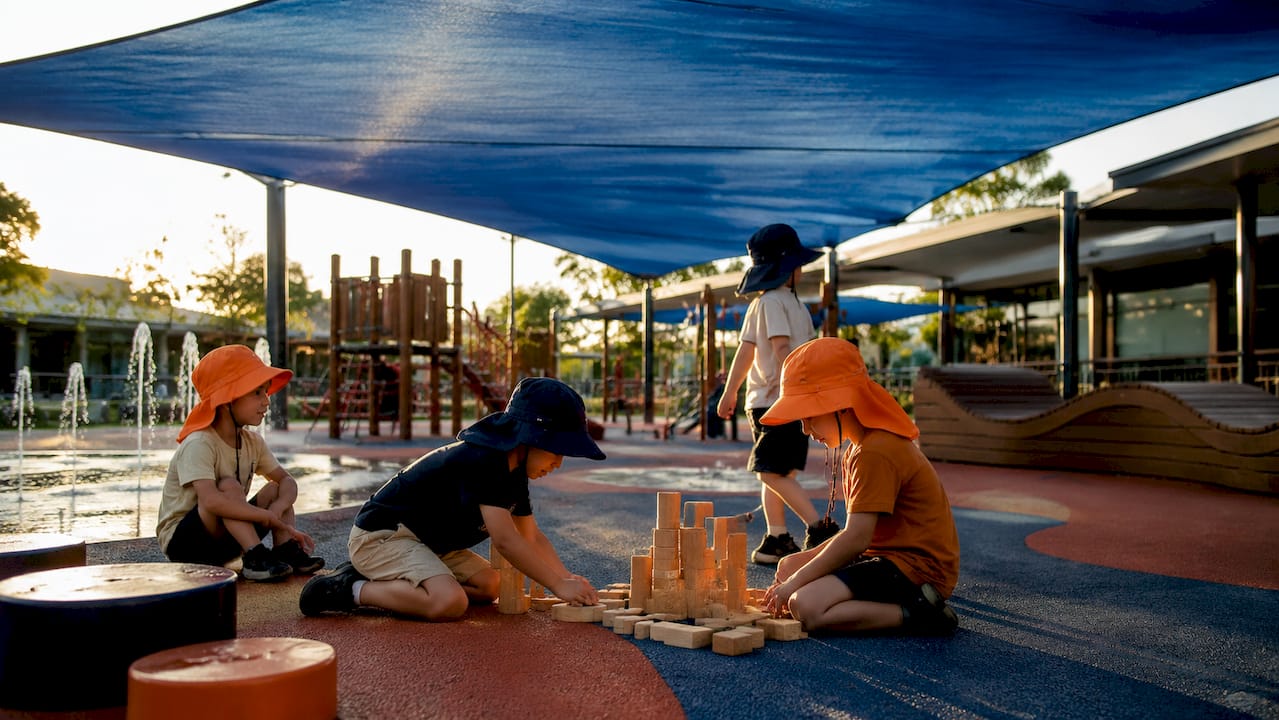
Behavioral measures are the daily enforcement layer. The most widely used rule is “No Hat, No Play,” which requires students without adequate head coverage to stay in shaded or covered areas rather than play in direct sun. This rule, used by schools like Our Lady of the Sacred Heart College, Darra, gives staff a clear, consistent standard to apply without judgment calls.
Scheduling is the most underused tool in most plans. UV Index-based scheduling means moving outdoor activities to times when the UV Index is below 3. Skin damage can begin at UV Index 3 regardless of temperature or cloud cover. That fact surprises most parents and educators, and it is the single most important concept to communicate when building community buy-in.
Here are the core components every plan needs:
- Shade access: Identified shaded zones for all recess periods, with a shade audit completed at least once per year
- Hat policy: Written “No Hat, No Play” rule with clear staff instructions
- Sunscreen protocol: SPF 30+ broad-spectrum sunscreen available at school, with scheduled reapplication breaks
- UV scheduling: Outdoor activity timing tied to daily UV Index forecasts, not temperature
- Protective clothing: UPF 50+ hats and tightly woven, skin-covering clothing as the standard for outdoor play
- Community education: Parent communication about expectations, gear requirements, and the UV Index threshold
Pro Tip: Download the free BANZ Protect app to get real-time UV Index readings for your school’s exact location. Set an alert at UV Index 3 so staff know when protection measures must be active.
How to implement and enforce sun protection rules during recess
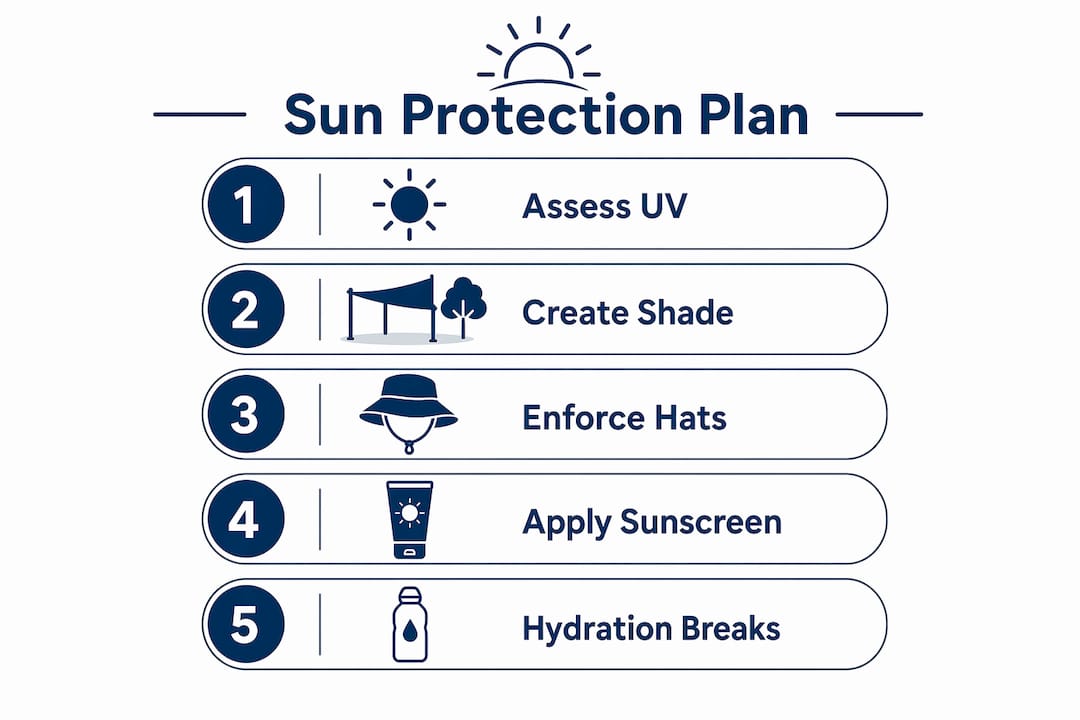
Clear rules mean nothing without consistent enforcement. The gap between a written policy and daily practice is where most school sun safety plans break down.
Follow these steps to move from policy to practice:
- Write the rule in plain language. Post “No Hat, No Play” in classrooms, on the playground gate, and in the parent handbook. Ambiguity gives staff an excuse to skip enforcement on busy days.
- Train every staff member. Teachers, aides, and yard supervisors all need the same briefing. Cover the UV Index threshold, the hat rule, sunscreen station locations, and what to do when a child is non-compliant. BANZ has a practical resource on training staff on sun protocols that schools can adapt.
- Set up sunscreen stations. Place SPF 30+ broad-spectrum sunscreen dispensers at the playground entrance and near water fountains. Structured reapplication breaks with supervisor coverage make reapplication practical rather than optional.
- Use access control as the compliance mechanism. When a child arrives at recess without a hat, the default action is relocation to a shaded area, not a verbal warning. This removes the inconsistency of individual staff judgment.
- Model the behavior. Adults wearing hats and applying sunscreen before outdoor duty sends a stronger message than any poster. Staff role-modeling is one of the fastest ways to normalize sun-safe habits in school culture.
- Review compliance monthly. Track how often children arrive without hats or sunscreen. Use that data to adjust communication with parents and refine the policy.
Pro Tip: Schedule sunscreen reapplication as a named activity on the recess timetable, not as an afterthought. Treat it the same way you treat a bathroom break before outdoor time.
What tools and resources support an effective sun protection plan?
The right gear and resources remove friction from daily enforcement. When sunscreen is available on-site and hats meet UPF standards, compliance goes up because the barriers go down.
Recommended sun protection products
| Tool | Standard | Purpose |
|---|---|---|
| Broad-spectrum sunscreen | SPF 30+ water-resistant | Applied before recess, reapplied every 2 hours |
| Sun hat | UPF 50+ broad-brimmed or legionnaire style | Covers face, ears, and neck |
| Protective clothing | UPF 50+ tightly woven fabric | Covers arms and shoulders during play |
| UV Index app or monitor | Real-time local UV data | Triggers protection measures at UV Index 3+ |
| Shade audit worksheet | Generation SunSmart format | Maps high-exposure zones on school grounds |
SPF 30+ broad-spectrum sunscreen combined with UPF 50+ hats is the product standard used by leading childcare providers. These two items together cover the most common failure points: unprotected scalp and neck, and skin that is exposed during active play when clothing shifts.
Shade audits are a practical starting point for schools that do not know where to begin. Generation SunSmart’s shade audit tool helps staff map sun exposure across the playground at different times of day. The output tells you exactly where to add shade structures or redirect play during peak UV hours.
Additional resources worth building into your plan:
- UV Index apps: Weather.gov, the EPA’s UV Index app, and the BANZ Protect app all provide local UV forecasts
- Educational lesson plans: Generation SunSmart and the Cancer Council offer free classroom materials that teach children why sun protection matters, not just what to do
- Signage: Clear, visible signs at playground entrances reinforce the hat rule and remind children to apply sunscreen before heading out. Tools like school safety signage can support parent engagement and visible policy communication on school grounds
Understanding UPF 50+ protection for kids is worth the time for any parent or educator selecting gear. Not all hats labeled “sun hat” meet the UPF 50+ standard, and the difference in UV blocking is significant.
How can schools and parents collaborate on consistent sun safety?
Sun protection policy for outdoor play only works when the school and home are aligned. A child who wears a hat at school but never at home does not build the habit. Consistent messaging across both environments is what creates lasting behavior change.
Education Queensland frames sun safety as a structured risk management system built through community consultation. That framing matters. When parents are involved in developing the policy, they are more likely to reinforce it at home and supply the right gear.
Practical collaboration strategies include:
- Term-start communication: Send a sun safety letter at the start of each school term. Include the UV Index threshold, the hat rule, and a list of approved hat styles.
- Gear checklists: Provide parents with a simple checklist: UPF 50+ hat, SPF 30+ sunscreen in the school bag, and a long-sleeve layer for cooler days with high UV.
- Feedback channels: Create a simple way for parents to flag when the policy is not being enforced or when their child is struggling to comply. A short term-end survey works well.
- Community consultation: Involve parents in annual policy reviews. Schools that consult families before updating sun safety rules see stronger compliance and fewer objections.
- Shared resources: Point parents to the same UV Index tools the school uses. When families check the same app, conversations about sun protection become consistent rather than contradictory.
Parental involvement in sun safety is not just a nice addition to a school policy. It is the mechanism that turns a school rule into a lifelong habit.
What challenges come up and how do you solve them?
Every school that tries to create a sun safety awareness program runs into the same barriers. Knowing them in advance makes them easier to manage.
Kids forgetting hats is the most common issue. The solution is not more reminders. It is a spare hat box at the playground entrance, funded by the parent association or school budget. Children who forget their hat grab a spare rather than sitting out.
Weather misconceptions are the most dangerous barrier. Many parents and staff assume UV risk only exists on hot, sunny days. That assumption is wrong.
Skin damage can begin at UV Index 3 regardless of temperature or cloud cover. A cool, overcast day in spring can carry the same UV risk as a clear summer afternoon. Scheduling outdoor play based on temperature alone leaves children unprotected on some of the highest-UV days of the year.
Limited shade is a real infrastructure problem, but it does not have to stop a plan from launching. Portable shade sails cost far less than permanent structures and can be deployed in days. Prioritize the areas where children spend the most time: lunch tables and high-traffic play zones.
Hydration is often left out of sun safety plans entirely. The CDC’s guidance explicitly includes hydration breaks alongside sunscreen reapplication. Heat stress and UV exposure compound each other, so water access during recess is part of the protection plan, not a separate issue.
Schools that have successfully adapted their plans share one common trait: they treat sun safety as an ongoing system, not a one-time policy launch. Annual reviews, staff retraining, and parent communication updates keep the plan current and effective.
Key takeaways
A recess sun protection plan requires layered environmental controls, written policy, consistent enforcement, and school-family alignment to reduce children’s UV exposure effectively.
| Point | Details |
|---|---|
| UV Index is the trigger | Start protection measures when UV Index reaches 3, regardless of temperature or cloud cover. |
| Layered protection works best | Combine shade, UPF 50+ hats, SPF 30+ sunscreen, and scheduling for full coverage. |
| Enforcement needs a mechanism | “No Hat, No Play” with relocation to shade removes inconsistency from daily enforcement. |
| Parents must be aligned | Send gear checklists and UV Index tools home so protection habits carry beyond school. |
| Review the plan annually | Use shade audits and compliance data to update the policy each school year. |
What i’ve learned from watching sun safety plans succeed and fail
By Shari M. Murphy
After reviewing dozens of school sun safety policies, the pattern is clear: the plans that fail are the ones built entirely on reminders. A poster in the hallway and a note in the newsletter do not change behavior. What changes behavior is a system with a consequence, a physical resource, and an adult who models it.
The “No Hat, No Play” rule is the single most effective enforcement tool I have seen, but only when it is applied without exceptions. The moment a staff member lets a child play in the sun without a hat because it is “just five minutes,” the rule loses its credibility with every child who watched it happen.
The UV Index misconception is the issue I spend the most time correcting. Parents routinely underestimate UV risk on cool or cloudy days. Once you show someone the data, that UV Index 3 threshold becomes the most useful number in their parenting toolkit.
My strongest recommendation: get the BANZ Protect app on every supervising adult’s phone before the plan launches. Real-time UV data removes the guesswork and gives staff an objective reason to enforce protection measures, even when the weather does not feel dangerous.
— Shari M. Murphy
Gear up your school’s recess sun protection plan with BANZ
Building a solid outdoor sun protection plan takes the right gear as much as the right policy. BANZ offers UPF 50+ sun hats designed specifically for children, built to meet the standards that schools and childcare centers rely on for “No Hat, No Play” enforcement.
BANZ has protected over 2 million families across six continents, and their children’s UPF 50+ sun hats are built to stay on active kids during recess. For younger children in early childhood settings, the reversible baby sun hats provide the same UPF 50+ coverage in a fit designed for smaller heads. The free BANZ Protect app adds real-time UV monitoring so you always know when protection measures need to be active. Shop the full range at usa.banzworld.com.
FAQ
What is a recess sun protection plan?
A recess sun protection plan is a structured set of policies and practices that reduce children’s UV exposure during outdoor school activities. It combines shade access, hat rules, sunscreen protocols, and UV-based scheduling into a single system.
When should sun protection measures be active during recess?
Sun protection measures should be active whenever the UV Index reaches 3 or above. Skin damage can begin at that level regardless of temperature or cloud cover, so UV Index is a more reliable trigger than weather conditions.
What sunscreen standard is recommended for school use?
Schools should provide broad-spectrum, water-resistant sunscreen rated SPF 30 or higher. Sunscreen should be applied before recess and reapplied every two hours, with supervised reapplication breaks built into the recess schedule.
What hat standard meets school sun safety requirements?
Hats should meet UPF 50+ protection and feature a broad brim or legionnaire-style design that covers the face, ears, and neck. Standard baseball caps do not provide adequate coverage for school sun safety policies.
How do you get parents to support the school’s sun safety plan?
Send a sun safety letter at the start of each term with gear requirements, the UV Index threshold, and a link to the UV monitoring tool the school uses. Community consultation in policy development increases parent ownership and compliance at home.
