

Educator sun protection modeling is the intentional demonstration of sun-safe behaviors by teachers and childcare professionals to shape children’s sun protection habits through direct observation. The CDC and Cancer Council SA both confirm that educators’ visible actions, wearing hats, applying sunscreen, and seeking shade, act as powerful non-verbal teaching tools that normalize sun safety for children. The SKCIN Sun Safe Schools programme reached 845,000 children between 2012 and 2023 with measurable improvements in children choosing sun protection independently. The role of educator sun protection modeling goes well beyond policy compliance. It is the single most consistent influence on whether children treat sun safety as a habit or an afterthought.
How does educator sun protection modeling influence children’s sun safety behaviors?
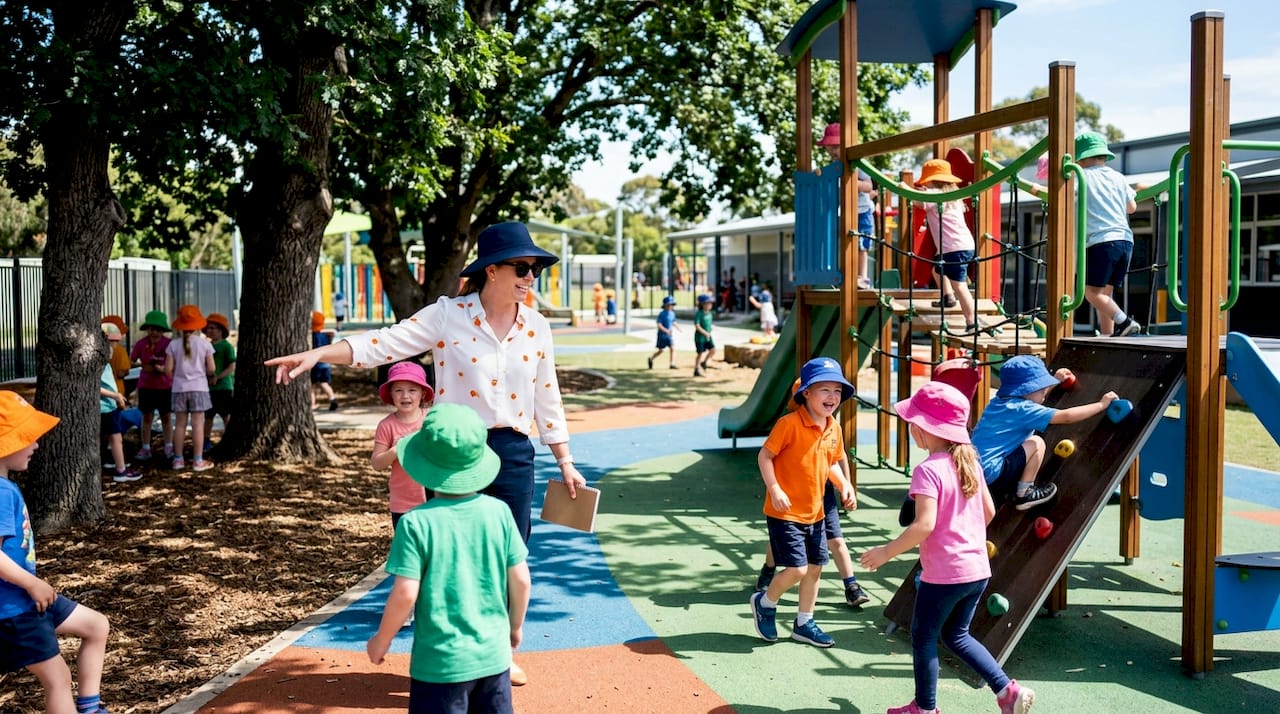
Children learn sun safety the same way they learn most behaviors: by watching the adults around them. When educators consistently wear wide-brimmed hats, apply sunscreen before going outside, and choose shaded areas for outdoor activities, they set a social norm. That norm becomes the default expectation in the classroom and on the playground.
Research confirms a strong link between educator modeling and student sun-safe choices. Schools with mandated sun-safe policies and active educator modeling see significant improvements in children choosing sun protection behaviors independently. The SKCIN Sun Safe Schools programme demonstrated this at scale, reaching 845,000 children across more than a decade with consistent behavioral outcomes.
The South Australian Department for Education takes this seriously at the policy level. It mandates Cancer Council SA-endorsed SunSmart training for all staff, a program that has protected approximately 135,000 children and educators in a single year. That number reflects what happens when modeling is treated as a professional responsibility rather than a personal choice.
Non-verbal cues carry particular weight with young children. An educator who silently reaches for sunscreen before stepping outside communicates more than a five-minute lesson ever could. Key mechanisms that drive this influence include:
- Normalization: Repeated visible behavior makes sun protection feel ordinary, not optional.
- Social proof: Children are more likely to adopt behaviors they see peers and trusted adults performing.
- Habit formation: Embedding UV index checks and sun protection reminders into morning circle time shifts sun safety from awareness to habitual behavior.
- Trust transfer: Children associate sun protection with care and competence when it comes from a trusted adult.
What practical strategies can educators use to model sun safety effectively?
Effective sun protection modeling does not require extra lesson time. It requires consistent, visible behavior woven into the existing daily routine. The following strategies give educators a clear starting point.
-
Wear protective gear every time you go outside. A wide-brimmed hat and UV-protective clothing are the most visible signals you can send. Children notice when adults skip this step, and they draw conclusions from it.
-
Apply sunscreen visibly and narrate the action. Say out loud, “I’m putting on sunscreen before we head out because the UV index is high today.” This turns a personal habit into a teaching moment without adding a formal lesson.
-
Check the UV index during morning circle time. Free tools like the BANZ Protect app provide real-time UV monitoring. Assign a child to read the UV level each morning and decide together whether hats and sunscreen are needed. This builds health literacy and critical thinking alongside sun safety habits.
-
Set up a visible sun protection station. Place sunscreen, spare hats, and protective clothing in an accessible, clearly labeled spot near the outdoor exit. Visible sun protection stations with accessible supplies help embed sun safety into everyday play rather than framing it as a restrictive rule.
-
Use transitions as teaching moments. The walk from the classroom to the playground is the ideal time to narrate sun-safe choices. “Let’s check our hats before we go out” takes five seconds and reinforces the habit every single day.
-
Involve children in sun safety tasks. Assign roles such as “sunscreen reminder” or “shade finder” during outdoor activities. Peer reminders and shared responsibility develop ownership of sun safety rather than dependence on adult prompts.
Pro Tip: Avoid framing sun protection as a chore or interruption. When you treat it as a normal part of going outside, children internalize it the same way. The goal is a culture, not a checklist.
Effective sun safety lessons, according to guidance from the Melanoma Fund UK and Mollie’s Fund, last about 60 minutes and focus on practical life skills rather than awareness alone. That principle applies to daily modeling too. Skills practiced repeatedly in context stick far longer than information delivered once.
How can outdoor learning environments support sun protection modeling?
The physical environment either reinforces or undermines an educator’s modeling efforts. An outdoor space with no shade, no sunscreen station, and no clear sun-safe cues sends a conflicting message regardless of what educators say or do.
Providing shade, scheduling outdoor activities wisely, and maintaining clear sun protection policies are the three environmental levers educators and administrators can control. The CDC and Cancer Council SA both recommend these as foundational elements of a sun-safe school or childcare setting.
| Strategy | Approach | Combined benefit |
|---|---|---|
| Shade structures | Permanent sails, trees, covered play areas | Reduces UV exposure during peak hours (10 a.m. to 4 p.m.) |
| Sunscreen stations | Accessible dispensers near outdoor exits | Removes the barrier of remembering to bring sunscreen |
| Scheduling | Outdoor activities before 10 a.m. or after 4 p.m. | Avoids peak UV index windows |
| Policy | Written sun-safe rules for staff and children | Creates consistent expectations across all educators |
| Curriculum integration | UV checks in morning routines, sun safety in science units | Connects environmental design to learning outcomes |
Shade and sunscreen work best together. Shade alone does not block all UV radiation, particularly reflected UV from light-colored surfaces. Sunscreen fills that gap. Educators who model both, seeking shade and applying sunscreen, demonstrate the complete picture rather than a partial solution.
Pro Tip: Advocate for at least one permanent shade structure in your outdoor learning area. Even a single sail shade over the main play zone changes behavior. Children naturally gravitate toward it, and educators can use it as a default gathering point.
Reviewing your center’s school sun protection policy is a practical first step for any educator who wants to align their personal modeling with a broader institutional commitment.
What are the challenges in educator sun protection modeling, and how can they be overcome?
Consistent modeling is harder to maintain than it sounds. Educators face real obstacles, and acknowledging them is the first step toward addressing them.
Common challenges include:
- Inconsistent habits across staff. One educator who skips the hat undermines the message from three who wear one. Consistency across the entire team is what creates a norm.
- Time pressure. Outdoor transitions are often rushed. Sun protection steps feel like one more thing to manage when the schedule is tight.
- Lack of training or resources. Educators who have not received formal sun safety training are less likely to model confidently. The mandatory SunSmart training model from South Australia shows that institutional requirements, not individual motivation, produce consistent results.
- Treating sun safety as a one-time lesson. A single sun safety unit in spring does not build habits. Habits come from daily, visible repetition.
Leadership buy-in is the most effective solution to most of these challenges. When center directors and school principals model sun-safe behavior themselves and include sun safety in staff performance expectations, the behavior spreads. Authentic behavior rather than administrative compliance is what builds trust and habit in children.
Families are also a critical part of the equation. When educators share sun safety practices with parents through newsletters, app updates, or brief conversations at pickup, the modeling extends beyond school hours. Children who see the same behavior at home and at school adopt it far faster.
Pro Tip: Start a brief monthly “sun safety check-in” at staff meetings. Review what is working, what gear needs restocking, and whether the UV station is visible and accessible. Five minutes of team alignment prevents months of inconsistency.
For educators looking for sun safety activities that children actually engage with, pairing modeling with hands-on tasks produces the strongest results.
Key Takeaways
Educator sun protection modeling is the most direct and consistent method for building lifelong sun-safe habits in children, and it requires authentic daily behavior, not occasional lessons.
| Point | Details |
|---|---|
| Modeling drives behavior | Children adopt sun-safe habits faster when they observe educators practicing them consistently every day. |
| Policy and training matter | Mandatory training programs, like South Australia’s SunSmart model, produce consistent staff behavior across entire schools. |
| Environment reinforces modeling | Shade structures, sunscreen stations, and smart scheduling amplify the impact of educator behavior. |
| Authenticity beats compliance | Children respond to genuine, narrated sun-safe actions, not educators who apply sunscreen only when reminded. |
| Family involvement extends reach | Sharing sun safety practices with families ensures modeling continues outside school hours. |
Why educator modeling is the piece most schools get wrong
I have spent years watching sun safety programs roll out in schools and childcare centers, and the pattern is almost always the same. The policy gets written. The sunscreen station gets installed. A lesson gets delivered in october before summer starts. And then nothing changes.
The missing piece is almost never resources. It is the educator standing in the playground without a hat, checking their phone while children run into direct sunlight. Children are watching that, and they are learning from it whether we intend it or not.
What actually works is the educator who makes sun protection visible and unremarkable. The one who says “grabbing my hat” on the way out the door every single day without making it a production. That behavior, repeated hundreds of times across a school year, is worth more than any curriculum unit. The Generation SunSmart curriculum gets this right by building sun safety into daily routines rather than treating it as a standalone topic.
The educators I have seen make the biggest difference are not the ones running the best sun safety lessons. They are the ones who have simply made sun protection a personal non-negotiable, and let children observe that over time.
— Shari M. Murphy
Sun protection gear educators and caregivers can rely on
Modeling sun safety is easier when you have the right gear on hand for yourself and the children in your care.
BANZ offers UPF 50+ sun protective hats, UV swim goggles, and outdoor gear designed specifically for children from infancy through school age. The BANZ Outdoor Hero bundle for ages 5–8 gives educators and parents a practical, ready-to-use set of sun protection tools built for active outdoor play. BANZ products are used by families across six continents and are built to the same standard educators need when modeling sun-safe behavior in real outdoor learning environments. Check the full sun safety gear checklist to make sure your outdoor setup covers every protection layer.
FAQ
What is educator sun protection modeling?
Educator sun protection modeling is the deliberate practice of teachers and childcare professionals demonstrating sun-safe behaviors, such as wearing hats, applying sunscreen, and seeking shade, so children learn by direct observation.
Why does educator modeling matter more than sun safety lessons alone?
Repeated visible behavior builds habits in ways that one-time lessons cannot. Children who observe consistent sun-safe actions from trusted adults are significantly more likely to adopt those behaviors independently.
What sun safety behaviors should educators model every day?
Educators should wear a wide-brimmed hat, apply SPF 30 or higher sunscreen before going outside, seek shade during peak UV hours (10 a.m. to 4 p.m.), and check the UV index as part of the morning routine.
How can educators overcome inconsistency across staff?
Mandatory training programs, leadership modeling, and brief regular team check-ins are the most effective tools. South Australia’s SunSmart mandatory training model shows that institutional requirements produce more consistent results than individual motivation alone.
What resources support sun safety education for educators?
The SKCIN Sun Safe Schools programme, Cancer Council SA’s SunSmart training, Generation SunSmart curriculum materials, and the free BANZ Protect app for real-time UV monitoring are all practical starting points for educators building a sun-safe culture.