

Toddler sunglasses with UV protection are defined as eyewear that blocks 100% of UVA and UVB rays, confirmed by a “UV400” label on the lens or frame. Choosing the right pair matters more than most parents realize. Toddlers’ eyes transmit more UV radiation to the retina than adult eyes do, because their ocular lenses are exceptionally clear. That clarity is a developmental feature, not a flaw. But it means every minute of unprotected sun exposure carries real risk. Brands like BANZ, Baby Sunnies, and Ki ET LA build their entire product lines around this fact. This guide covers how to choose sunglasses for toddlers with UV protection, from reading labels correctly to getting a pair your child will actually keep on.
Why toddlers need sunglasses that block 100% UVA and UVB
UV damage to children’s eyes is cumulative and largely invisible until it becomes a clinical problem. The American Academy of Ophthalmology links early UV exposure to cataracts and macular degeneration later in life. Starting protection early is the most direct way to reduce that lifetime risk.
UVA, UVB, and uv400: what the labels actually mean
UVA rays penetrate deep into the eye and contribute to long-term retinal damage. UVB rays are shorter and more intense, causing surface damage to the cornea and lens. A lens labeled “UV400” blocks all light wavelengths up to 400 nanometers, which covers both UVA and UVB completely. That label is the only reliable indicator of real protection.
The single most important rule in this guide: lens darkness does not equal UV protection. A clear lens with UV400 certification protects better than a dark lens with no certification. Never buy toddler sunglasses based on tint color alone.
Parents often pick darker lenses thinking they offer more protection. Medical professionals consistently correct this. Health Canada and other authorities emphasize verified labeling over appearance or cost as the standard for UV protection. The UV-blocking chemical is in the lens material itself, not the tint.
One more fact worth knowing: up to 80% of UV rays penetrate cloud cover on overcast days. Sunglasses are not just a sunny-day item. Your toddler needs them at the beach, at the park, and on the walk to the car.
What features matter when selecting toddler sunglasses
Not all UV400 sunglasses are equal. The label confirms the lens material. The frame design, strap system, and build materials determine whether the glasses actually protect your child and stay on their face.
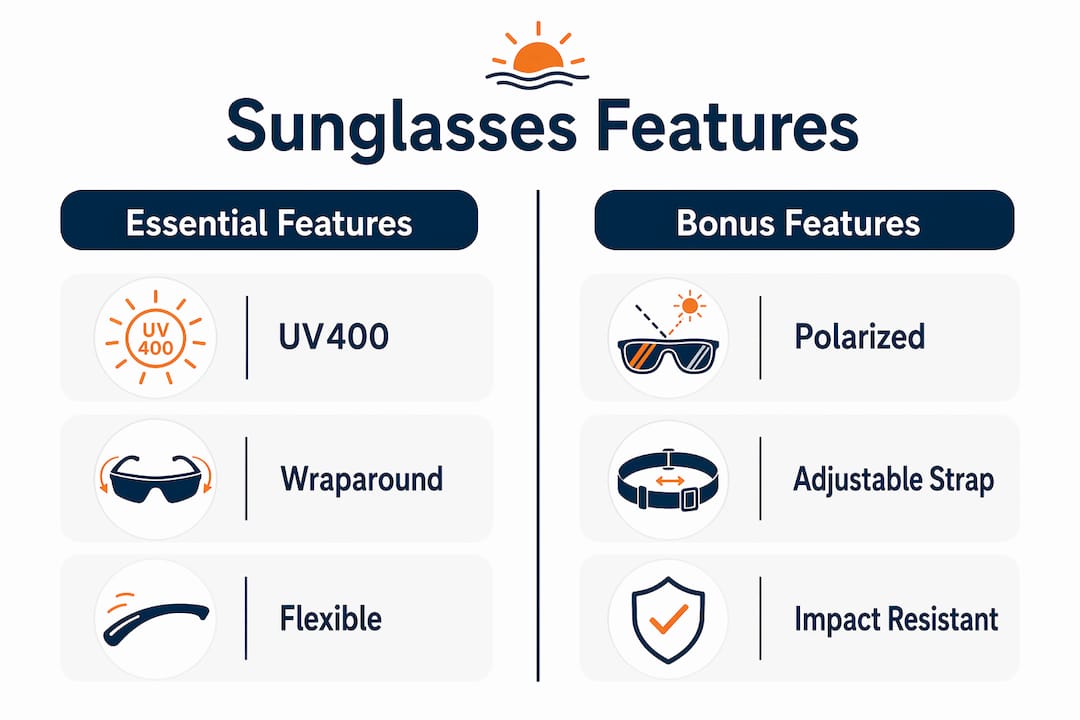
The five features to prioritize
- UV400 or 100% UVA/UVB certification. This is non-negotiable. Check the tag, the frame, or the product listing. If the label is absent, skip the product entirely.
- Wraparound or close-fitting frames. Side-glare from reflected UV light on water, snow, sand, and concrete can enter toddlers’ eyes from the sides. Wraparound frames block that angle. The National Eye Institute specifically recommends close-fitting wraparound designs for children.
- Flexible, BPA-free silicone frames. Silicone frames reduce injury risk when a toddler drops, chews, or bends the glasses. They also flex to fit different face shapes without cracking.
- Adjustable elastic straps. Wraparound frames with elastic straps keep sunglasses on during active play. Fixed temple arms slide off toddler faces constantly. A goggle-style strap is the most secure option for kids under three.
- Impact-resistant lenses. Polycarbonate lenses resist shattering. This matters when your toddler inevitably throws the glasses onto pavement.
Pro Tip: Polarized lenses reduce glare in high-reflection environments like pools and snowy playgrounds. They improve visual comfort but do not add UV protection beyond what UV400 already provides. Treat polarization as a comfort upgrade, not a safety requirement.
Lens category comparison
| Lens Category | Visible Light Transmission | Best Use Case |
|---|---|---|
| Category 1 | 43–80% | Light overcast days |
| Category 2 | 18–43% | Moderate sun, everyday outdoor use |
| Category 3 | 8–18% | Bright sun, beach, and park activities |
| Category 4 | 3–8% | Extreme conditions: alpine, snow, glacier |
Category 3 lenses cover the vast majority of toddler outdoor activities. Category 4 is reserved for extreme alpine or snow environments and is not suitable for everyday use.
How to get the right fit so toddlers keep them on
Fit is the most underrated factor in toddler eyewear safety. A perfectly certified pair of sunglasses provides zero protection if your child pulls them off after 30 seconds.
Sizing for toddler face shapes
Toddler faces are proportionally wider and flatter than adult faces. Adult sunglasses sit too low on the nose bridge and leave gaps at the sides. Look for frames specifically sized for ages 0–2 or 2–5, depending on your child’s age. The lens should sit close to the face without pressing against the eyelashes.
- Nose bridge: Should rest comfortably without pinching. Soft silicone nose pads help on flat nose bridges.
- Temple width: Frames that are too wide slide forward and fall off. Too narrow and they pinch at the temples.
- Lens height: Should cover the eye fully without the bottom edge resting on the cheek.
Getting toddlers to actually wear them
Resistance is normal. Most toddlers reject sunglasses the first few times. The solution is gradual exposure, not force.
- Let your toddler pick the frame color or style. Ownership increases compliance.
- Start with short sessions of 5–10 minutes outdoors. Extend wear time each day.
- Pair sunglasses with a wide-brimmed sun hat for backup protection on days when the glasses come off.
- Praise and reward wearing. Toddlers respond to positive reinforcement more than instruction.
Pairing sunglasses with hats and shade while gradually increasing wear time is the most reliable method for building tolerance. Patience matters more than any product feature.
Pro Tip: Adjustable elastic straps that mimic swim goggles increase toddler acceptance significantly. The snug, secure feel is familiar and reduces the urge to pull them off during active play.
Step-by-step guide to choosing and introducing toddler sunglasses
This process takes about 10 minutes of research and a week of gradual introduction. Follow these steps and you will have a toddler who wears their sunglasses consistently.
- Verify the UV label first. Before anything else, confirm the product states UV400 or 100% UVA/UVB protection. Check the product listing, the hang tag, or the lens itself. No label means no verified protection.
- Compare frame designs by activity. Beach and pool days call for wraparound frames with elastic straps. Casual park outings work with standard close-fitting frames. Match the design to how your child spends time outdoors.
- Check materials. Confirm BPA-free silicone or polycarbonate construction. Avoid metal frames for toddlers under three. Metal edges can scratch and the fit is harder to adjust.
- Try them at home first. Put the sunglasses on indoors before the first outdoor use. Let your toddler look in a mirror. Adjust the strap. Fix any pinching or sliding before you are standing in a parking lot.
- Introduce outdoors gradually. Start with a 10-minute outdoor session. Keep a hat available as backup. Praise every minute they stay on.
- Reward consistency. After a week of short sessions, most toddlers accept sunglasses as part of the outdoor routine. Sticker charts or small rewards accelerate this process.
Brand and feature comparison
| Brand | UV Rating | Strap Type | Frame Material | Best For |
|---|---|---|---|---|
| BANZ | UV400 | Elastic adjustable | BPA-free silicone | All-day outdoor use |
| Baby Sunnies | UV400 | Elastic | Flexible plastic | Beach and pool |
| Ki ET LA | UV400 | Elastic | Rubber | Everyday wear |
No minimum age exists for starting UV eye protection. Babies and toddlers both benefit from wearing suitable sunglasses outdoors. Starting early builds the habit before resistance sets in.
You can explore UV-protective toddler sunglasses sized specifically for ages 0–5 to find the right fit for your child’s stage.
Key takeaways
Choosing toddler sunglasses for UV protection requires UV400 certification, wraparound frames, flexible materials, and a secure strap system to deliver real protection your child will actually wear.
| Point | Details |
|---|---|
| UV400 label is mandatory | Only buy sunglasses that explicitly state UV400 or 100% UVA/UVB protection. |
| Lens darkness is not protection | A clear UV400 lens protects better than a dark lens with no certification. |
| Wraparound frames block side UV | Reflected UV from water, sand, and concrete enters from the sides without wraparound coverage. |
| Fit determines compliance | Properly sized, strap-secured sunglasses stay on toddlers during active play. |
| Start protection early | There is no minimum age for UV eye protection; begin as soon as your child goes outdoors. |
What i’ve learned after years of watching parents choose toddler sunglasses
By Shari M. Murphy
The most common mistake I see is parents buying based on looks. A cute frame in a fun color feels like a win at checkout. Then the glasses slide off, the toddler throws them, and they sit in the bottom of the diaper bag for the rest of the summer.
Fit is everything. A pair that stays on a moving, squirming toddler is worth ten pairs that look great in photos. I always tell parents to test the strap tension before they leave the store. If you can pull the glasses off with one finger, your toddler will pull them off in under a minute.
The other thing most articles skip: start indoors. Let your child wear the sunglasses inside for a few days. Let them look in the mirror. Make it normal before you add the distraction of being outside. That single step cuts resistance in half.
I also want to push back on the idea that UV protection is a summer concern. UV exposure is a year-round issue, and the effects of UV on toddler eyes accumulate over a lifetime. The habit you build now matters more than any single beach trip.
Prioritize certified protection over price. A $12 pair with no UV label is not a bargain. A $25 pair with UV400 certification, a secure strap, and a flexible frame is the practical choice. Spend on the features that matter and skip the ones that do not.
— Shari M. Murphy
Protect your toddler’s eyes with BANZ
BANZ has built UV-protective eyewear for toddlers since the brand’s founding in Australia, and every pair in the BANZ lineup carries UV400 certification with BPA-free silicone frames and adjustable elastic straps. The BANZ toddler wrap-around sunglasses are designed specifically for active kids who need secure coverage from all angles.
Beyond sunglasses, BANZ offers a full range of sun safety gear including rashguard and swim diaper sets and wide-brimmed hats for complete outdoor coverage. You can also store your child’s sunglasses safely between outings with a children’s sunglass case built to handle toddler-level wear and tear. Visit the BANZ shop to find the right fit for your child’s age and activity level.
FAQ
What does uv400 mean on toddler sunglasses?
UV400 means the lens blocks all light wavelengths up to 400 nanometers, covering 100% of both UVA and UVB rays. This label is the only reliable indicator of full UV protection in children’s eyewear.
Do dark lenses protect toddlers’ eyes better?
No. Lens tint does not determine UV protection. A clear lens with UV400 certification provides full protection, while a dark lens without certification may offer none at all.
What age should toddlers start wearing sunglasses?
There is no minimum age for UV eye protection. Babies and toddlers both benefit from wearing certified sunglasses whenever they are outdoors, including on cloudy days when up to 80% of UV rays still reach the ground.
Are polarized lenses worth it for toddlers?
Polarized lenses reduce glare in high-reflection environments like pools, beaches, and snowy playgrounds. They improve visual comfort but do not add UV protection beyond what UV400 already provides. They are a useful upgrade, not a safety requirement.
How do i keep sunglasses on an active toddler?
Choose frames with adjustable elastic straps, start with short indoor wear sessions, and let your toddler pick the color or style. Pairing sunglasses with a wide-brimmed hat gives backup coverage on days when the glasses come off.