

Getting a toddler to keep sunglasses on comes down to four things working together: UV400 polycarbonate lenses, an elastic strap for retention, letting your child pick the frame, and modeling the behavior yourself every time you head outside. Skip any one of these, and the other three have to work harder.
Try this checklist on your next outing:
- Put sunglasses on every single time you go outside, not just on “sunny enough” days.
- Offer two frame choices and let your toddler pick one.
- Secure the strap snugly before you leave the house, not after the meltdown starts.
- Praise the behavior briefly (“Nice shades!”) instead of making a production of it.
- If your toddler yanks them off, stay calm. No fight, no bargaining, just try again next time.
An optometrist-recommended pair with genuine UV400 protection matters more than a fashionable pair without it, and a trusted brand like BANZ builds that protection into designs made specifically for small, wiggly faces.
Pro Tip: Keep a pair of your own sunglasses by the door and put them on in front of your toddler before you both walk outside. Kids copy what they see far more readily than what they’re told.
Key Takeaways
Keeping sunglasses on a toddler works best when UV400 polycarbonate lenses, strap retention, correct sizing, and consistent parental modeling all happen together, not in isolation.
| Point | Details |
|---|---|
| Check the UV label | Confirm UV400 on the tag; tint darkness alone means nothing. |
| Prioritize strap retention | An elastic strap paired with a snug fit reduces removal attempts significantly. |
| Introduce gradually | Practice indoors first, then short outdoor tries, before expecting all-day wear. |
| Diagnose before fixing | Identify whether resistance is fit, sensory, novelty, or damage before changing gear. |
| Layer with BANZ sun hats | UPF 50+ hats with pocket or toggle fits keep protecting the eyes when sunglasses come off. |
Table of Contents
- Why You Need to Keep Sunglasses on Toddlers Consistently
- How Do You Choose Toddler Sunglasses That Actually Stay On?
- When Should You Start Introducing Sunglasses to a Toddler?
- What Gear and Tactics Keep Toddler Sunglasses On the Longest?
- Why Won’t My Toddler Keep Sunglasses On? Troubleshooting Common Problems
- BANZ Sun and Hearing Protection Built for Active Toddlers
- When Should You Consult an Eye-Care Professional About Sunglasses?
- An Editor’s Note on Realistic Expectations
- Get BANZ Sun Protection That Works With Your Toddler’s Sunglasses
- Frequently Asked Questions
- Sources
Why You Need to Keep Sunglasses on Toddlers Consistently
Toddler eyes let in more UV light than adult eyes because their lenses are still clear and developing, so the case for consistent wear isn’t cosmetic. Three things are happening at once when your toddler squints against the sun without protection.
First, there’s the immediate discomfort: glare causes squinting, headaches, and crankiness that shows up as a meltdown you can’t quite explain. Second, cumulative UV exposure in childhood is linked to a higher lifetime risk of cataracts and macular degeneration, damage that builds silently over decades. Third, the skin around a toddler’s eyes is thinner than an adult’s, making it more vulnerable to sun damage from the same exposure.
Pediatric eye specialists generally support this timeline:
- Around 6 to 12 months: introduce strap-retained sunglasses for outdoor stroller time.
- From 1 year: start building the daily habit consistently.
- UV exposure happens even on cloudy days, so the habit shouldn’t depend on how bright it looks outside.
How Do You Choose Toddler Sunglasses That Actually Stay On?
Three product essentials predict whether sunglasses survive past the first outing: genuine UV400 polycarbonate lenses, elastic strap retention, and correct sizing. Get these right and your behavior strategies actually have something to work with.

Lens material and labeling. Polycarbonate lenses resist impact far better than glass or CR-39 plastic, which matters when your toddler faceplants during a game of chase. A dark lens without that rating can actually make things worse: pupils dilate behind the shade, letting in more unfiltered UV than no sunglasses at all.
Frame design. Flexible, rubber-like frames bend instead of snapping when a toddler sits on them, and wraparound styles block side-angle light that a flat-front frame lets leak in. Anti-scratch coatings extend the life of a pair that’s going to end up in a sandbox at some point.
Sizing. A frame that’s too wide slides down and invites removal; too narrow and it pinches at the temples. For toddlers, look for a lens width in the 40 to 46mm range with a narrow bridge fit, and size up slightly if your child has a rounder face shape for comfort over a tight seal.
| What to Check | Why It Matters | Label to Look For |
|---|---|---|
| Lens material | Impact resistance protects against falls and rough play | Polycarbonate |
| UV rating | Actual eye protection, not just cosmetic shade | UV400 |
| Retention method | Determines whether the pair survives past outing one | Elastic strap or wraparound band |
Skip anything from the toy aisle or a dollar-store bin. Sunglasses without a verified UV rating offer no real protection no matter how good the tint looks, and that gap is exactly what parents miss when price drives the decision.
When Should You Start Introducing Sunglasses to a Toddler?
The most reliable introduction routine follows a simple sequence: brief indoor practice, then short outdoor tries, then a consistent “sun’s out, shades on” rule repeated daily. Rushing straight to a full day outside is where most parents lose the battle before it starts.
Here’s a protocol you can run over a week or two:
- Day 1 to 2: Let your toddler hold and explore the sunglasses indoors, no pressure to wear them.
- Day 3 to 4: Put them on for two or three minutes during a favorite indoor activity, like watching a show.
- Day 5 to 6: Try them for a short walk to the mailbox or car, then take them off yourself before removal becomes a game.
- Week 2: Extend wear time gradually, always pairing it with something your toddler already enjoys outside.
- Ongoing: Repeat the “sun’s out, shades on” phrase every time, until it’s as automatic as buckling a car seat.
Strap-frame sunglasses work from around 6 months for stroller rides and tummy time outdoors. Real habit-building, where your toddler starts reaching for them unprompted, tends to click closer to 12 months and beyond.
Pro Tip: Chain sunglasses to a routine your toddler already accepts, like sunscreen or shoes. “First sunscreen, then shades, then shoes” turns an optional battle into one predictable sequence they stop questioning.
What Gear and Tactics Keep Toddler Sunglasses On the Longest?
The single most reliable mechanical fix is an adjustable, soft elastic strap paired with a properly fitted frame. Strap retention changes the entire compliance equation: it takes real effort to pull a strapped pair off, and most toddlers give up trying once the novelty wears off.
Not all straps are equal:
- Neoprene fabric straps are soft against skin and adjust easily as your toddler grows; reviews consistently show they reduce loss during active play.
- Silicone loop straps grip better in water or sweat but can feel tighter against sensitive ears.
- Detachable elastic bands let you remove the strap once your toddler is older and more reliably keeping frames on solo.
Hats are a strong complement, not a replacement, especially on days when sunglasses get refused outright. BANZ’s Children’s Sun Hats with UPF 50+ Protection with Pocket shade the eyes from above even when frames come off mid-outing, and a toggle-fit hat keeps the brim from blowing back on windy playground days. A hat with sequins, like the Hello Sunshine sunhat, can also double as the “choice” option, giving your toddler a say in their sun gear even on the days sunglasses lose.
For toddlers who resist anything touching their face, gradual desensitization works better than pushing through resistance. Try sunglasses for five seconds at a time, then ten, using a mirror so your toddler can see themselves and often laugh at the novelty. Play “sunglasses on, sunglasses off” as a game rather than a chore.
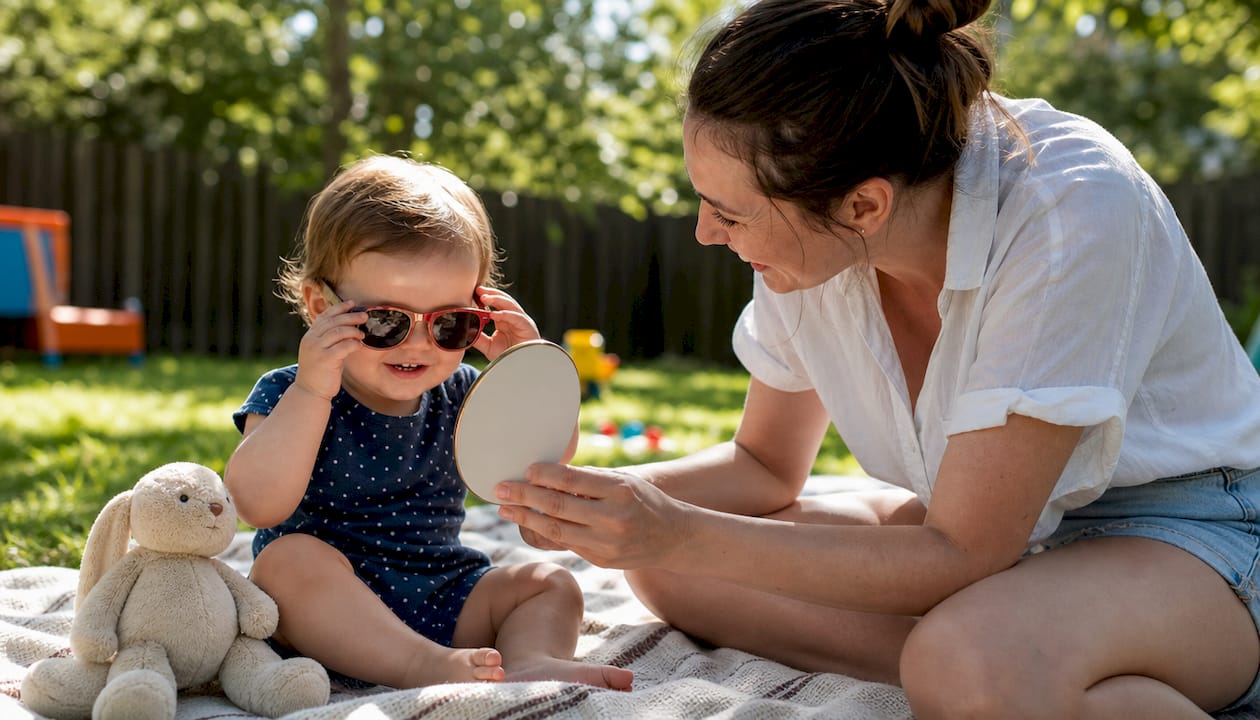
Maintenance keeps a pair appealing longer than you’d expect. Wipe lenses with a microfiber cloth (never a shirt hem, which scratches coatings), check the strap for stretched-out elastic monthly, and replace any pair with a scratched lens immediately since scratches distort vision and invite more squinting, not less.
Pro Tip: If your toddler sees you wearing sunglasses every time you’re both outside, the behavior normalizes faster than any bribe or sticker chart ever will.
Why Won’t My Toddler Keep Sunglasses On? Troubleshooting Common Problems
Before fixing anything, diagnose the actual cause: is it fit, sensory sensitivity, novelty resistance, or damage? Each has a different fix, and guessing wrong wastes a week of frustration.
- Fit problem: Frame slides down or pinches → adjust the strap or size up to a wider bridge.
- Sensory issue: Toddler bats at frames constantly → shorten wear sessions and pair with a positive activity.
- Novelty resistance: Sudden refusal after weeks of success → offer two frame choices again and re-model the behavior.
- Damage: Scratched or bent lens → replace rather than force continued wear.
Fogging usually means a fit that’s too tight against the face; loosening the strap slightly improves airflow. Glare on bright water or snow days is where polarized lenses genuinely help, cutting reflected light that a standard tint doesn’t block.
A few safety rules apply no matter what: never let an infant fall asleep in sunglasses, avoid any pair with small detachable parts that pose a choking risk, and skip toy-aisle sunglasses entirely since most carry no verified UV rating.
Quick answers: Will my toddler ever stop fighting this? Usually yes, within a few weeks of consistent exposure. Is polarization necessary? No, but it helps with glare off water, sand, or snow. What if they never keep them on? Default to a wide-brim hat and shade until the habit clicks.
BANZ Sun and Hearing Protection Built for Active Toddlers
BANZ designs child-specific protection that pairs naturally with UV-rated sunglasses, built around the same durability and fit standards that make sunglasses actually stay on. If sunglasses come off during a beach afternoon or stroller walk, a properly fitted UPF 50+ sun hat keeps shading the eyes and face without a battle.
For outdoor days that include both sun and noise, like a beach trip or outdoor festival, BANZ’s product range covers both fronts:
- Sun coverage: Children’s Sun Hats with UPF 50+ Protection with Pocket, the sequined Hello Sunshine Sunhat, and Children’s Sun Hats with UPF 50+ Protection with Toggle for a secure fit on windy days.
- Hearing protection: Baby Hearing Protection Earmuffs, Kids Hearing Protection Earmuffs in solid colors, and Baby Hearing Protection Earmuffs in prints for infants who need noise reduction at fireworks shows or sporting events.
- Family safety: the free BANZ Protect app tracks real-time UV index and noise levels, so you know when it’s genuinely time to reach for the shades or the earmuffs.
Pro Tip: Stock a hat as backup gear in the diaper bag. On days sunglasses get refused, a hat brim still protects the eyes from above without any negotiation required.
When Should You Consult an Eye-Care Professional About Sunglasses?
Most toddlers can start with strap-retained sunglasses around 6 months, with habit-building kicking in near 12 months. See an eye-care professional if you notice eye asymmetry, cloudiness, excessive tearing, or if sunglasses leave lasting skin indentations or visible discomfort.
Other red flags worth a visit: persistent eye turning or crossing, unusual discharge, or abnormal pupil size in either eye. None of these are sunglasses problems, but they’re worth ruling out before you assume the resistance is purely behavioral.
Pro Tip: If your toddler has a diagnosed sensory sensitivity or strong tactile aversion to anything touching their face, loop in your pediatrician or an occupational therapist for a desensitization plan tailored to your child.
An Editor’s Note on Realistic Expectations
These tactics work because they respect how toddlers actually operate: through repetition, small choices, and watching the adults around them, not through explanation or bribery. That’s what makes them realistic for parents who don’t have the bandwidth for a daily standoff.
Pro Tip: Keep one pair of your own sunglasses sitting by the front door. Seeing you reach for yours before you both step outside does more to normalize the routine than any reward chart.
Expect incremental progress, not a clean win on day one. Some days the sunglasses stay on for an entire outing; other days they come off in the driveway. Consistency in trying matters more than any single outing’s result.
Get BANZ Sun Protection That Works With Your Toddler’s Sunglasses
BANZ built its product range because a family once couldn’t find sun and noise protection gear that actually fit small children well, so the brand focuses entirely on solving that gap. For a toddler who resists sunglasses some days, layering in a UPF 50+ hat means the eyes and face still get shade even when frames come off mid-outing.
If your toddler is in a phase of refusing sunglasses altogether, start with the Children’s Sun Hats with UPF 50+ Protection with Toggle for a secure, no-slide fit that survives a stroller nap or a playground sprint. Parents managing both sun and noise exposure on the same outings, like a beach day with fireworks or a crowded fair, can pair that hat with BANZ’s hearing protection earmuffs for full coverage in one trip. Browse the current sun hat and sunglasses lineup and pick the pieces that fit your toddler’s outdoor routine today.
Frequently Asked Questions
At what age should I start putting sunglasses on my toddler? Strap-retained sunglasses work from around 6 months old for stroller rides and outdoor tummy time. Real habit-building for keeping sunglasses on toddlers tends to start closer to 12 months.
Why does my toddler hate sunglasses so much? Most toddlers resist anything new touching their face, not sunglasses specifically. Gradual exposure in short sessions, paired with letting them choose the frame, usually resolves this within a few weeks.
What are the best sunglasses for toddlers who move constantly? Look for flexible, rubber-like frames with wraparound coverage and an elastic strap. These hold up to active play far better than rigid, strapless styles.
Do polarized lenses matter for toddlers? Polarization helps cut glare off water, sand, and snow but isn’t required for everyday UV protection.
Is it safe to use a strap on toddler sunglasses? Yes, as long as the strap has no small detachable parts and fits snugly without pinching. Avoid straps with beads or clips that could pose a choking risk.
This article is general information, not a substitute for advice from a qualified doctor. Consult a qualified healthcare professional about your own circumstances before acting on anything here.
Sources
- What Makes a Great Pair of Kids’ Sunglasses? | Duplin Eye Associates
- Baby and Toddler Sunglasses: What Actually Works | Navi Eyewear
- 5 Proven Ways To Get Kids To Wear Sunglasses - Tippett Eye Care Center
