

Construction noise can absolutely harm your baby’s hearing, and the risk is real enough that pediatric researchers have written formal guidance about it. Jackhammers, drills, and dump trucks routinely produce sound at or above 100 decibels at the source, well past the 85-decibel threshold where prolonged exposure starts causing permanent damage. Your baby cannot move away from a loud room, cover their own ears, or tell you their ears hurt. That job falls entirely on you.
Three things matter most right now:
- Move your baby, even temporarily, out of rooms facing active work and away from shared walls.
- Use properly fitted baby earmuffs during supervised exposure, never as a substitute for distance.
- Protect sleep by relocating the crib, sealing gaps, and layering in white noise to mask sudden peaks.
Call your pediatrician if you notice your baby startling less than usual, sleeping unusually poorly, or showing no reaction to loud sounds at all.
Key Takeaways
Protecting a baby from construction noise requires immediate distance, correctly fitted supervised earmuffs, and sleep-space adjustments, backed by prompt medical follow-up if warning signs appear.
| Point | Details |
|---|---|
| Know the threshold | Sound above 85 decibels for prolonged periods risks permanent hearing damage; many construction tools exceed 100 decibels at the source. |
| Prioritize distance | Move your baby away from windows and shared walls facing active work before reaching for any device. |
| Fit earmuffs correctly | Check for a full cushion seal and use earmuffs only during supervised sessions, never unsupervised sleep. |
| Watch for red flags | Missed startle responses, delayed babbling, or ear discharge warrant a pediatrician call. |
| Choose the right gear | BANZ baby hearing protection earmuffs are sized and cushioned for infant ears, with prints and combo sets available for daily use. |
This article is general information, not a substitute for advice from a qualified doctor. Consult a qualified healthcare professional about your own circumstances before acting on anything here.
Table of Contents
- How Loud Is Construction, and Why Are Babies More Vulnerable?
- What Can You Do Right Now to Protect Your Baby?
- Fast, Low-Cost Ways to Quiet a Room
- Don’t Forget the Dust: Air Quality Matters Too
- When Should You Call a Pediatrician or Audiologist?
- How BANZ Helps You Protect Your Baby’s Hearing
- Sources
How Loud Is Construction, and Why Are Babies More Vulnerable?
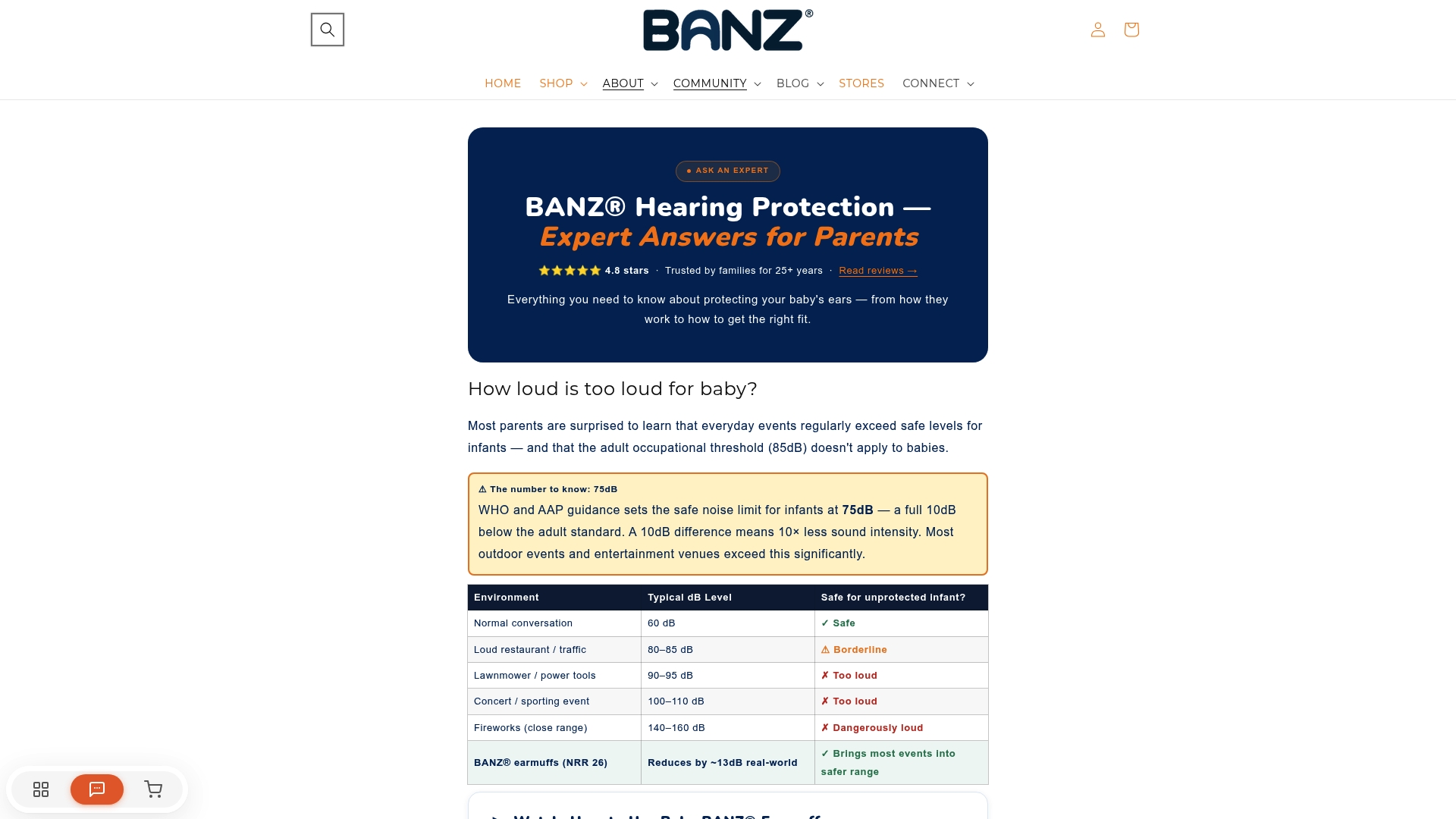
The 85-decibel mark is the line where the National Institute for Occupational Safety and Health and pediatric audiologists agree that hearing damage becomes a real possibility with sustained exposure. A jackhammer, circular saw, or pile driver working outside your window doesn’t just brush past that number, it often blows through 100 decibels at the source, and sound compounds as it echoes off pavement, siding, and glass.
Babies aren’t just smaller versions of adults when it comes to hearing. Their ear canals are shorter, which changes how sound pressure reaches the eardrum, and their auditory pathways are still wiring themselves during the first years of life. The American Academy of Pediatrics has stated plainly that infants cannot self-regulate away from hazardous noise, so caregivers carry the entire responsibility for reducing exposure.
Chronic, unpredictable environmental noise doesn’t just threaten hearing. It triggers measurable physiological stress responses, including elevated heart rate and disrupted sleep, in children exposed to it regularly.
That stress response matters as much as the hearing risk. A baby who can’t settle because a demolition crew starts at 7 AM every day isn’t just cranky. Their body is running on a low-grade alarm system that research links to real physiological strain.
What Can You Do Right Now to Protect Your Baby?
Speed matters more than perfection here. You don’t need a renovated nursery by tomorrow, you need a plan you can execute in the next hour.
- Create distance first. Move your baby to the room farthest from the active work zone, ideally on the opposite side of the house or on a different floor entirely.
- Fit hearing protection correctly. Baby earmuffs work only when the cushions form a complete seal around the ear. Check that the band sits snugly without pinching, and test the fit by speaking normally at arm’s length; if you can hear yourself clearly, the seal isn’t tight enough.
- Limit continuous sessions. Earmuffs are for supervised wear during active noise events, not for unattended naps or overnight sleep. Take breaks, check comfort, and reposition frequently since infants move and earmuffs shift.
- Cut background noise at home. Skip the vacuum or blender during loud construction windows so your baby’s total noise load doesn’t stack on top of what’s already coming through the walls.
- Never leave a baby unattended near an active work zone, even briefly, since falling debris and dust are separate hazards from noise alone.
Pro Tip: Test earmuff fit weekly as your baby grows. A seal that worked perfectly last month can loosen fast during a growth spurt, and a gapped cushion barely reduces noise at all.
Fast, Low-Cost Ways to Quiet a Room
You don’t need a contractor to meaningfully cut the noise reaching your baby’s crib. Soft materials absorb sound far better than bare walls and hard floors, and a few targeted changes can knock several decibels off what filters through.
- Seal gaps around doors and windows with weatherstripping or a draft snake; even small gaps let in surprising amounts of sound.
- Hang heavy, lined curtains over windows facing the construction site.
- Move the crib away from shared walls and windows toward the quietest interior corner of the room.
- Layer in rugs, upholstered furniture, and wall hangings to absorb rather than reflect sound waves.
- Run a white-noise machine at a steady, moderate volume to mask sudden bangs and drilling without adding to the room’s total volume.
If your home borders a long-term project, like a multi-month renovation or a new build next door, upgrading interior doors or adding acoustic panels to a nursery wall is worth a real conversation with a contractor. Quick fixes buy you time; structural changes solve the problem for good.
Don’t Forget the Dust: Air Quality Matters Too
Noise isn’t the only construction hazard reaching your baby. Demolition and heavy renovation kick up dust, debris particles, and sometimes fumes that irritate developing lungs.
- Keep windows and doors closed on the side facing active work, even when it’s tempting to air out the house.
- Run a HEPA air purifier in your baby’s room, especially during demolition phases.
- Wet-wipe surfaces and vents after major work days instead of dry-dusting, which just recirculates particles.
- Keep your baby out of active work areas entirely, and ask contractors to seal off workspaces with plastic sheeting.
- Consider staying elsewhere during the heaviest demolition days if the project is inside or attached to your home.
Persistent coughing, wheezing, or labored breathing after exposure warrants a same-day call to your pediatrician, not a wait-and-see approach.
When Should You Call a Pediatrician or Audiologist?
Most babies exposed to nearby construction show no lasting effects once the project wraps up. But a few signs deserve a prompt call rather than a wait-and-see approach.
- Your baby doesn’t startle, blink, or turn toward sudden loud sounds.
- Speech or babbling milestones seem delayed compared to typical ranges for their age.
- You notice fluid, discharge, or repeated tugging at the ears.
- Sleep and behavior patterns shift noticeably and don’t improve once the noisiest phase ends.
Ask about a hearing recheck if your baby’s newborn screening was borderline or if construction exposure has been intense and prolonged. Keep a simple log of dates, duration, and estimated loudness of major noise events. A dated record gives your pediatrician far more to work with than “it’s been loud for a while.”
How BANZ Helps You Protect Your Baby’s Hearing
Fit and supervision decide whether hearing protection actually works, which is why BANZ builds baby hearing protection earmuffs around an adjustable, cushioned band designed to seal properly on small, fast-growing heads.
- Baby earmuffs and prints for infants who need daily supervised protection near loud work zones.
- A combo set pairing earmuffs with wraparound sunglasses for families managing noise and sun exposure at once.
- Kids’ earmuffs in solids and prints for toddlers and older siblings on the same job site or block.
- The free BANZ Protect app for real-time noise monitoring, plus a noise-safety resource library built for exactly this situation.
Read the full fit and safety guidance before your first supervised session, and store earmuffs somewhere dry and dust-free between uses.
A Reassuring Word From Shari M. Murphy
Loud construction near your home feels alarming, and that instinct to protect your baby is exactly right. The steps here work: distance, proper-fit protection, and a quieter sleep space cover most of the risk. Lean on your pediatrician for anything that doesn’t feel right.
— Shari M. Murphy
Give Your Baby Real Protection Today
BANZ built its earmuffs for exactly the situation you’re facing: loud, unpredictable noise your baby can’t escape on their own. Unlike generic foam plugs or adult-style hearing protection stretched to fit a small head, BANZ earmuffs are sized and cushioned specifically for infants and toddlers, so the seal actually holds during a jackhammer session or a noisy moving day next door.
If your baby needs hearing protection today, start with the baby hearing protection earmuffs or the prints collection if you want a pattern that matches your baby’s personality. Managing sun exposure on top of noise? The earmuffs and sunglasses combo set covers both in one order. Check current stock and place your order today.
Sources
- Noise-induced hearing loss in children — Johns Hopkins Medicine
- Preventing Excessive Noise Exposure in Infants, Children, and Adolescents — Pediatrics (AAP)
- Healthychildren
- Noise and health effects — NCBI / PubMed Central
Recommended
- Noise Safety for Children: Everyday Sounds Parents Should Watch |BANZ® – BANZ® Carewear USA
- Kids Noise Safety Resource Library | Hearing Protection & Sensory Support | BANZ® – BANZ® Carewear USA
- Infant Sound Safety for Doulas, Nurses & New Parent Educators | BANZ® – BANZ® Carewear USA
- Infant Sound Safety for Doulas, Nurses & New Parent Educators | BANZ® – BANZ® Carewear USA