

The best sun shade hats combine certified UPF 50+ fabric with adequate brim or drape geometry. Without both, you are not getting the protection the label implies. Here is what that means in practice:
- Protection baseline: Look for the Skin Cancer Foundation Seal of Recommendation, which requires a minimum UPF 50 fabric rating. That means the fabric blocks at least 98% of UV radiation.
- Brim geometry rule: Adults need a sufficiently wide brim or bill plus a permanent drape to ensure good coverage. Infants and toddlers under size 5T need a brim sized proportionally for their smaller heads to provide effective sun protection.
- Who needs full-coverage models most: Children, infants, and anyone spending extended time on water, snow, or open terrain where UV reflects from multiple angles.
For parents, BANZ® children’s UPF 50+ hats are a family-focused option built to meet these coverage standards, with secure fit features designed for active kids.
Table of Contents
- Which hat type fits your activity?
- How do you choose the right sun hat?
- How does washing and packing affect UPF performance?
- Why UPF rating alone does not tell the whole story
- Key Takeaways
- The case for treating UPF and fit as one decision, not two
- BANZ® children’s sun hats: built for real family use
- Authoritative sources and further reading
Which hat type fits your activity?
Different hat styles offer different levels of coverage. Knowing the trade-offs helps you pick the right one for your situation.
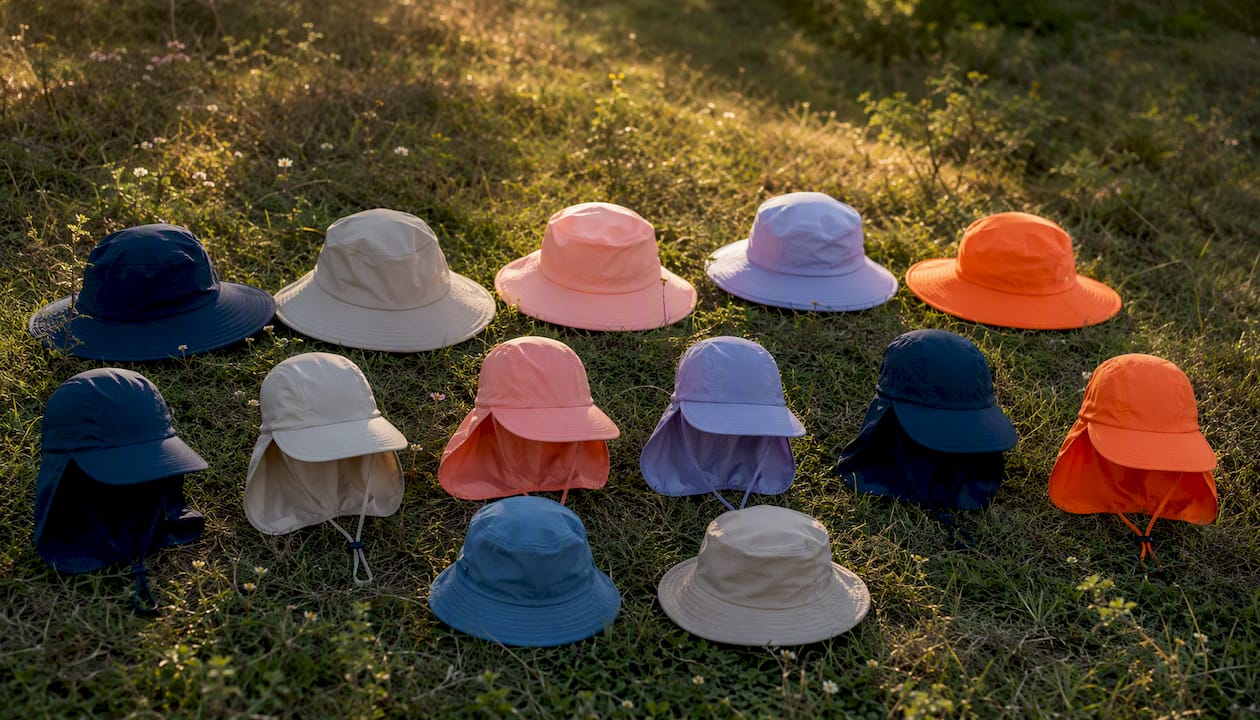
- Wide-brim hat (3"+ brim): Best all-around face, neck, and ear coverage. Slightly less packable in structured versions. Ideal for beach, gardening, and general outdoor use.
- Bucket hat: Shorter brim (typically 2"–2.5") that wraps 360 degrees. Good for casual outdoor use and kids. Less coverage than a wide-brim but more packable and secure in wind.
- Cap with neck flap (sun hat with back flap): A sun hat with flap or sun hat with back flap adds a drape or cape to a standard bill cap. Excellent neck coverage, sporty fit, and popular for hiking and water sports. Field testing shows that caped hats and long neck capes deliver the best neck and face protection of any hat style.
- Visor: Protects the face but leaves the crown of the head fully exposed. Not recommended as a primary sun hat for high-UV conditions.
- Straw hat: Depends entirely on weave tightness. Loosely woven straw with visible holes has no reliable UPF rating. Tightly woven straw can perform well but is harder to verify without a lab rating.
- Packable/travel hat: Usually a wide-brim or bucket style made from crushable synthetic fabric. Convenient for travel; verify the UPF rating holds after packing, since some structured brims lose shape.
A swimming sun hat or sun hat for the pool needs additional properties: quick-dry fabric, resistance to chlorine and salt, and a secure chin strap. UPF-rated synthetic fabrics (polyester, nylon) handle repeated water exposure better than cotton or straw.
| Activity | Recommended hat type | Key feature to prioritize |
|---|---|---|
| Beach / open water | Wide-brim or caped hat | Brim of at least 3 inches for adults, UPF 50+, chin strap |
| Hiking / trail | Cap with neck flap | Neck drape, ventilation, packable |
| Pool / swimming | Bucket or wide-brim swim hat | Quick-dry, chlorine-resistant, secure fit |
| Gardening / yard | Wide-brim | Brim of at least 3 inches for adults, breathable fabric |
| Travel / city | Packable wide-brim | Crushable, lightweight, UPF 50+ |
| Kids’ outdoor play | Bucket or wide-brim with chin strap | Brim of at least 2½ inches for infants/toddlers, toggle or strap, UPF 50+ |
| Boating / water sports | Caped hat or wide-brim with strap | Neck coverage, wind retention, quick-dry |
How do you choose the right sun hat?
Work through these steps before buying:
- Verify UPF 50+. Check for a fabric UPF rating on the label or hang tag, not just a marketing phrase. The Skin Cancer Foundation Seal of Recommendation is the clearest third-party signal.
- Measure the brim or drape. Adults: 3 inches minimum. Kids under size 5T: 2½ inches minimum. If the hat has a bill plus a neck drape, the drape must be permanent, not removable.
- Check fit and adjustability. A hat that blows off or gets pulled off provides no protection. Look for adjustable drawstrings, toggles, or chin straps.
- Test ventilation and sweatband. Mesh panels or eyelets help in heat, but check where they sit relative to the crown. A sweatband keeps the hat in place and improves comfort on long wear days.
- Consider packability and weight. A structured wide-brim is ideal for the beach but awkward in a carry-on. A crushable synthetic version travels better. Confirm the brim geometry holds after packing.
Questions to ask before buying:
- Will you need neck coverage? If yes, skip the standard wide-brim and look for a sun hat with back flap or a caped design.
- Do you need water resistance? Synthetic fabrics (polyester, nylon) dry faster and resist chlorine and salt better than cotton.
- Will you wear it with a ponytail or bun? Some bucket hats and wide-brim styles include an opening at the back. Check before buying.
- Can it pack flat or roll without permanent damage to the brim?
Red flags to avoid:
- Loose straw weaves with visible holes and no UPF rating
- “UV-protective” marketing language with no fabric test rating or certification
- Crown vents positioned directly over the scalp without a wide enough brim to compensate
- Removable neck drapes that are sold as a protection feature but are not attached
For sizing and fit, face shape affects how a brim looks but not how it protects. A wider brim flatters rounder faces by adding vertical proportion; a medium brim works on most face shapes. For hair types, thick or natural hair adds height inside the crown, so size up or look for adjustable internal bands. A ponytail opening is a practical feature for anyone with longer hair, and it does not reduce brim coverage.
Pro Tip: The hat you actually wear every time beats the hat with the highest UPF rating sitting in your bag. Comfort and fit determine consistency, and consistency determines protection.
For toddler hat fit guidance, head circumference measurement is the most reliable starting point.
How does washing and packing affect UPF performance?
UPF ratings are tested on new fabric under lab conditions. Real-world use changes that. Here is how to maintain performance:
- Rinse after pool or ocean use. Salt and chlorine degrade synthetic fibers over time. A fresh-water rinse after each swim session extends fabric life.
- Hand wash or use a gentle machine cycle. Aggressive washing cycles cause abrasion and stretching that loosen the weave and reduce UPF performance.
- Air dry away from direct sunlight. High heat from dryers can break down UV-absorbing treatments applied to some fabrics.
- Store structured brims flat or on a hat form. Folding a structured brim repeatedly causes permanent creasing that changes the brim angle and reduces coverage.
Signs that a hat needs replacing:
- Visible fabric thinning or pilling at the crown or brim edge
- Fading that indicates UV-absorbing dye or treatment has degraded
- Loose or open weave where the fabric has stretched or worn
- Brim that no longer holds its shape after washing
For packable hats, crushable synthetic fabrics are designed to return to shape after packing. Straw hats are not. If a straw hat develops permanent creases or gaps in the weave, the UPF performance is compromised regardless of the original rating.
A practical maintenance schedule: inspect hats at the start of each outdoor season, after any heavy-use period (a beach trip, a camping week), and whenever you notice visible wear. Most well-made UPF-rated synthetic hats hold their rating for multiple seasons with proper care. Straw and cotton hats need more frequent checks.
Why UPF rating alone does not tell the whole story
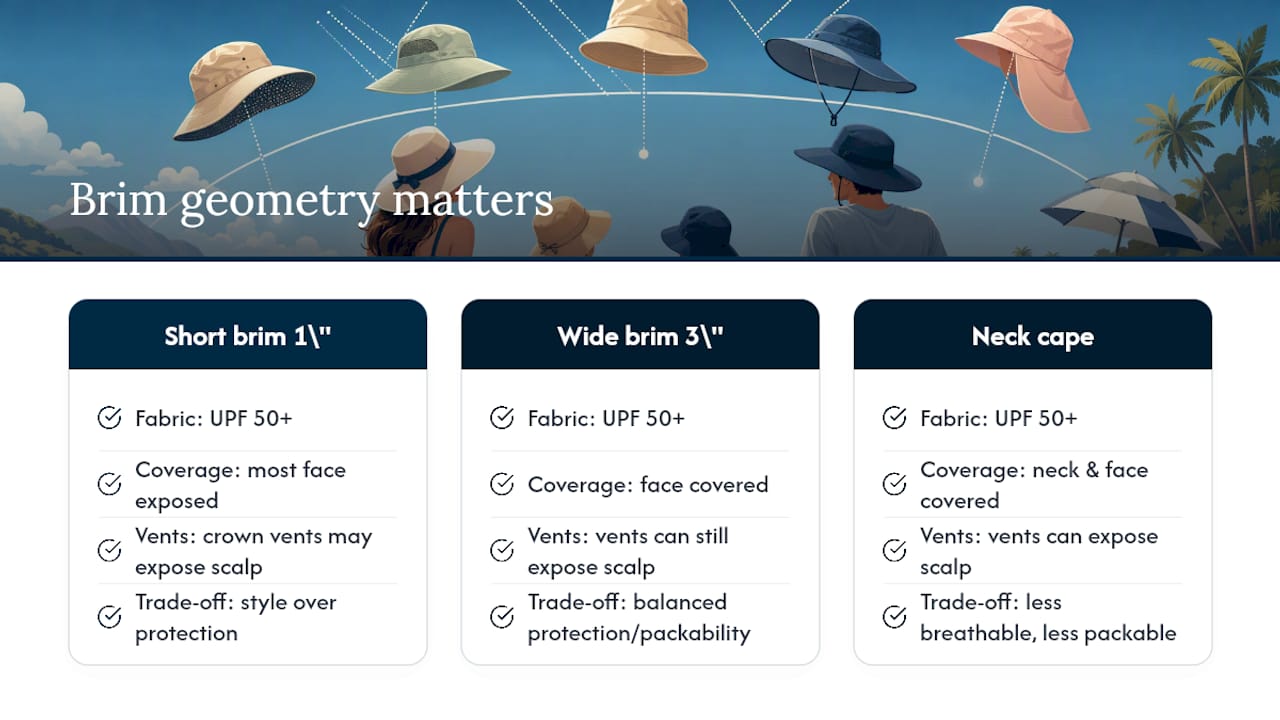
Two hats can carry identical UPF 50+ fabric ratings and deliver very different real-world protection. The difference is geometry.
The geometry gap: A hat’s brim width and drape angle determine which parts of your face, neck, and ears actually receive shade. Lab UPF testing measures how much UV passes through the fabric in a controlled setting. It does not measure how much UV reaches your skin around the hat’s edges, under a short brim, or through crown vents. A hat with a 1-inch brim and UPF 50+ fabric leaves most of your face exposed. A hat with a 3-inch brim and the same fabric rating covers it.
The Skin Cancer Foundation’s guidance explicitly couples UPF fabric rating with brim and drape geometry for this reason. UPF is meaningful only when the fabric actually covers the area you are trying to protect.
Wirecutter’s testing approach starts with a UPF 30 baseline fabric, then evaluates protection, comfort, and style through hands-on testing including UV card testing in real conditions. UV card testing catches gaps that lab ratings miss: brim angles that let UV in from below, reflective surfaces like water or snow that bounce UV upward under the brim, and crown vents that create direct exposure paths to the scalp.
Field testing consistently shows that caped hats and long neck capes outperform standard wide-brim hats for neck and face coverage in high-UV environments. The trade-off is breathability and packability, which is why activity matching matters. For outdoor activities with kids, a hat with a secure chin strap and adequate brim is the practical choice over a style-forward option with a shorter brim.
The practical takeaway: always evaluate brim width and drape alongside the UPF label. The PubMed research on UV exposure and skin outcomes supports physical barriers as effective protection, but only when the barrier actually covers the exposed area.
Key Takeaways
UPF 50+ fabric and a brim of at least 3 inches for adults (2½ inches for infants) are the two non-negotiable criteria for a sun hat that delivers real protection.
| Point | Details |
|---|---|
| UPF 50+ is the baseline | Look for the Skin Cancer Foundation Seal of Recommendation; it requires a minimum UPF 50 fabric rating. |
| Brim size determines coverage | Adults need at least a 3-inch brim; infants and toddlers under size 5T need at least a 2½-inch brim. |
| Shade first for infants | The AAD recommends shade and protective clothing as the primary defense for babies under six months. |
| Match hat type to activity | Caped hats for hiking and water sports; wide-brim for beach and gardening; quick-dry bucket for pool use. |
| BANZ® for family protection | BANZ® children’s UPF 50+ hats meet brim and fabric standards with kid-friendly fit features like toggles and adjustable straps. |
The case for treating UPF and fit as one decision, not two
Most hat-buying guides treat UPF rating and fit as separate considerations. Check the UPF label first, then figure out if it fits. That sequence is backwards.
A hat that does not stay on a child’s head during active play provides no protection at all. A hat with a 3-inch brim that a toddler immediately removes because the sweatband scratches is worse than a hat with a 2½-inch brim they actually wear. The geometry gap discussed in the research section is real, but there is a more common gap that gets less attention: the wearing gap. Parents often buy the hat with the best specs and discover their child refuses to keep it on.
This is why features like soft internal sweatbands, breakaway chin straps, and adjustable toggles are not comfort extras. They are protection features. A hat that stays on is a hat that works.
The same logic applies to adults. Wirecutter’s testing framework starts with UPF baseline, then evaluates comfort and wearability because a hat you leave in the car is not protecting you. The most protective hat is the one you wear consistently, in the right conditions, with the brim positioned correctly.
BANZ® builds children’s hats with this in mind. The product line reflects a practical understanding of how kids actually wear gear, not how they are supposed to wear it.
BANZ® children’s sun hats: built for real family use
BANZ® children’s UPF 50+ hats meet the coverage criteria covered in this article: certified UPF 50+ fabric, brim geometry sized for infants and children, and fit features that keep hats on during active outdoor use.
The BANZ® children’s sun hat range includes reversible styles, toggle closures, and options sized from infant through older child. Reversible designs give parents two looks in one hat without sacrificing the UPF rating on either side. The toddler reversible sun hats include adjustable toggles that keep the hat secure during outdoor play without uncomfortable pressure. For families who want a verified, washable, kid-tested option that covers the basics without guesswork, BANZ® is the practical next step. Browse the full children’s sun hat collection at usa.banzworld.com and add your size to cart.
Authoritative sources and further reading
The following sources were used in this article. Check them directly for primary guidance:
- Seal of Recommendation – Skin Cancer Foundation
- Sun-protective clothing – Skin Cancer Foundation
- Infant sun protection: How parents can keep their baby safe – AAD
- The 3 Best Sun Hats of 2026 | Reviews by Wirecutter
- PubMed – UV exposure and skin outcomes (selected study)
- Best sun hat – OutdoorGearLab
No single product covers every UV risk. Combine a UPF 50+ hat with shade, UPF-rated clothing, and broad-spectrum sunscreen for complete protection, especially for children and infants.
