

Ultraviolet radiation is divided into three types, UVA, UVB, and UVC, each with a distinct wavelength and a different effect on children’s skin. Understanding the types of UV radiation children face outdoors is the first step toward real protection. Children accumulate 60–80% of their lifetime UV exposure before age 18, and pediatric melanoma rates are rising by 2.9% annually. Only UVA and UVB reach the Earth’s surface. UVC is blocked entirely by the atmosphere. Each type requires a different protective response.
1. What are the types of UV radiation children are exposed to?
UV radiation divides into UVA, UVB, and UVC based on wavelength, measured in nanometers. UVA spans 320–400 nm, UVB spans 280–320 nm, and UVC spans 100–280 nm. The atmosphere absorbs UVC completely, so only UVA and UVB reach your child’s skin during outdoor play. UVA makes up about 94% of the UV radiation at ground level. UVB accounts for the remaining 6%, but it carries far more energy per photon.
Knowing which rays reach your child matters because each type damages skin differently. UVA penetrates deeply and causes long-term harm. UVB burns the surface quickly. Protection strategies must address both.
2. What is UVA radiation and how does it affect children’s skin?
UVA radiation is the most abundant UV type at ground level, making up 94% of ground-level UV exposure. Its longer wavelength lets it pass through the outer skin layer and reach the deeper dermis. That depth is what makes it particularly damaging over time.
UVA causes several specific harms to children’s skin:
- Premature skin aging. UVA breaks down collagen and elastin in the dermis. Up to 90% of visible skin aging is linked to UV damage, not chronological age.
- Immune suppression. Prolonged UVA exposure reduces the skin’s ability to fight cancerous cells and infections. This effect happens without any visible sunburn.
- Indirect DNA damage. UVA generates free radicals that attack DNA, increasing the risk of skin cancer over decades.
- Year-round presence. UVA intensity stays relatively constant across seasons and penetrates glass, meaning children receive UVA exposure even indoors near windows or in cars.
Children’s skin is thinner than adult skin, which means UVA penetrates proportionally deeper. The damage accumulates silently, with no immediate redness or pain to signal a problem.
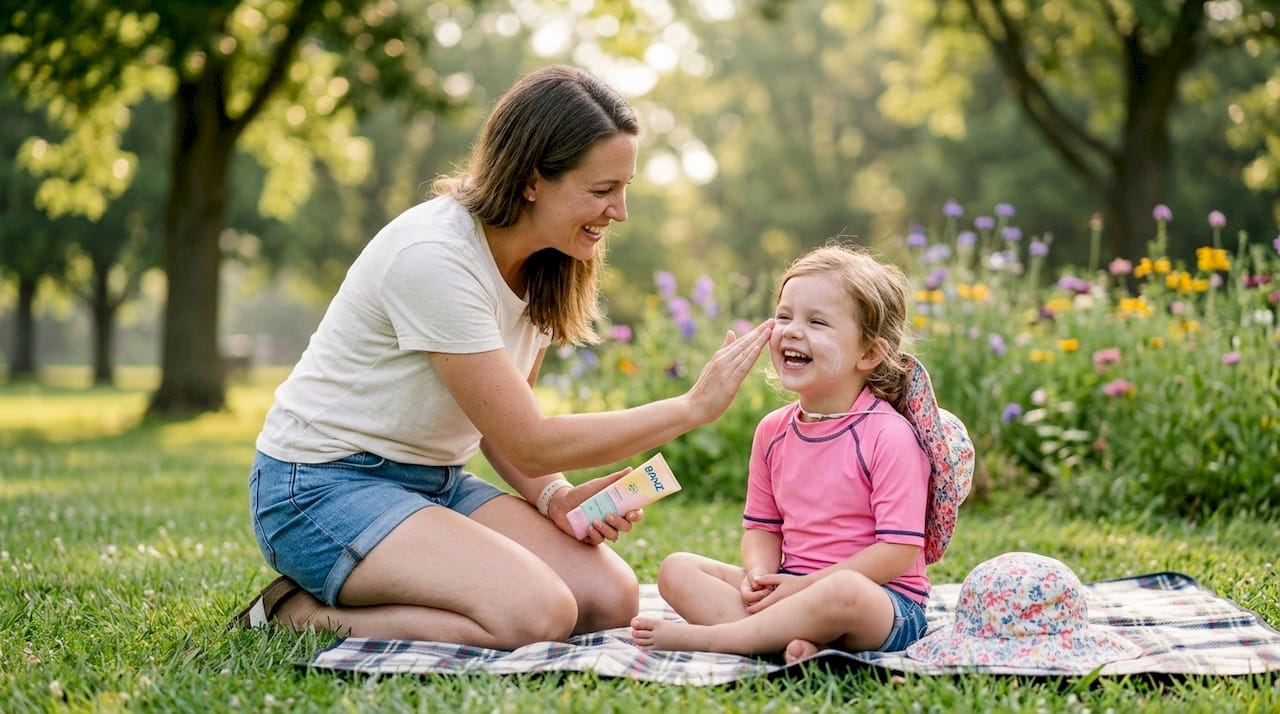
Pro Tip: Broad-spectrum sunscreen labeled “Broad Spectrum” in the U.S. covers both UVA and UVB. Check the label before buying. A product that only lists SPF protects against UVB but may leave your child’s skin unguarded against UVA.
UPF 50+ clothing blocks UVA and UVB without degrading or washing off. For full UVA coverage, combine UPF 50+ protective clothing with broad-spectrum sunscreen and UV-blocking sunglasses rated UV400.
3. What is UVB radiation and its specific risks for children?
UVB radiation spans 280–320 nm and carries more energy per ray than UVA. It is the primary cause of sunburn, direct DNA damage, and most cases of skin cancer. Although UVB makes up only 6% of ground-level UV, its biological impact is disproportionately high.
The key UVB risks for children include:
- Sunburn. UVB damages the outer skin layer rapidly. Sunburn can occur in as little as 15 minutes during peak UV hours on a bright day.
- Direct DNA damage. UVB causes thymine dimers in DNA strands. These mutations are the most common trigger for melanoma and squamous cell carcinoma.
- Cumulative risk from blistering burns. Children who experience two or more blistering sunburns carry a significantly higher skin cancer risk later in life.
- Seasonal and time-of-day spikes. UVB intensity peaks between 10 a.m. and 4 p.m. and is strongest in summer, at high altitudes, and near the equator.
UVB intensity varies more than UVA across the day and year. That variability creates a false sense of safety on cooler or partly cloudy days.
Pro Tip: Schedule outdoor activities before 10 a.m. or after 4 p.m. when UVB intensity drops significantly. If your child must be outside at peak hours, reapply SPF 30+ sunscreen every two hours and after any water exposure.
Physical barriers are the most reliable defense against UVB. Wide-brim hats, UPF-rated clothing, and shade structures block UVB before it reaches the skin. Sunscreen alone, applied thinly or missed on key areas like ears and the back of the neck, leaves gaps that physical barriers close.
4. Why UVC radiation is less relevant but worth understanding
UVC radiation occupies the 100–280 nm range and carries the highest energy of all three UV types. The ozone layer and atmosphere absorb it entirely before it reaches the Earth’s surface. Children face no natural outdoor UVC exposure.
Key facts about UVC for parents:
- No outdoor risk. UVC from the sun never reaches ground level under normal atmospheric conditions.
- Artificial sources exist. Certain germicidal sterilization lamps, used in hospitals and water treatment facilities, emit UVC. These are not found in typical home or school environments.
- Ozone layer dependence. Significant ozone depletion could theoretically increase UVC exposure in the future, but current levels pose no practical risk for children outdoors.
- Focus stays on UVA and UVB. All sun safety measures for children target UVA and UVB because those are the rays that actually reach your child’s skin.
Understanding UVC removes unnecessary worry. Parents can direct their attention fully toward UVA and UVB protection, which is where the real risk lives.
5. How environmental factors shape children’s UV exposure
Environmental conditions change how much UV radiation your child actually receives, often in ways that surprise parents. The most common mistake is assuming clouds or cool temperatures mean low UV risk.
| Condition | UV Effect |
|---|---|
| Overcast sky | Up to 80% of UV rays still penetrate cloud cover |
| Sand reflection | Reflects up to 15% of UV back onto skin |
| Snow reflection | Reflects up to 85% of UV radiation, nearly doubling exposure |
| Water surface | Reflects UV and reduces the cooling sensation that signals overheating |
| High altitude | UV intensity increases roughly 4% for every 1,000 feet of elevation gain |
Timing is the other major variable. UV intensity peaks between 10 a.m. and 4 p.m. daily. A child playing outside for two hours at noon receives far more UV than the same child playing for two hours at 8 a.m.
Cumulative exposure is the factor most parents underestimate. Children accumulate 60–80% of their lifetime UV dose before age 18. Short daily outdoor activities, a walk to school, a recess break, a trip to the park, add up across years. Protection cannot be reserved for beach days.
Pro Tip: Use the free BANZ Protect app to check real-time UV index levels before your child heads outside. When the UV index reaches 3 or higher, full protection measures apply regardless of how the sky looks.
Outdoor sun safety gear designed for children accounts for these environmental variables. Hats with wide brims protect the face, ears, and neck even when UV reflects off sand or snow.
6. Practical protection strategies against UVA and UVB for children
Effective UV protection for children combines multiple layers. No single method covers every exposure scenario.
Sunscreen
- Use broad-spectrum SPF 30+ for all children over six months of age.
- Infants under six months should avoid direct sunlight entirely. Sunscreen is not recommended for that age group.
- Reapply every two hours and immediately after swimming or sweating.
- Apply to all exposed skin, including ears, the back of the neck, and the tops of feet.
UPF clothing
- UPF 50+ certified garments block UVA and UVB without degrading or washing off, unlike sunscreen.
- Physical barriers cover areas that sunscreen misses consistently.
- Long-sleeve swim shirts and full-coverage hats are the most practical options for active children.
Sun hats
- Wide-brim hats protect the face, ears, and neck, the three areas most commonly missed by sunscreen.
- A brim of at least three inches provides meaningful shade for a child’s face.
- Check the sun hat guide for parents to match hat style to activity type.
UV400 sunglasses
- Children’s eyes are more vulnerable to UV damage than adult eyes. Their clearer lenses allow more UV to reach the retina, increasing the risk of cataracts and retinal damage over time.
- UV400-rated sunglasses block all UVA and UVB up to 400 nm. This is the standard to look for on any children’s eyewear.
Mindset shift
A tan is skin damage, not a sign of health. Sun safety applies to all children regardless of skin tone. Darker skin has more melanin, which offers some natural protection, but it does not eliminate UV damage or skin cancer risk.
| Protection method | Covers UVA | Covers UVB | Requires reapplication |
|---|---|---|---|
| Broad-spectrum SPF 30+ sunscreen | Yes | Yes | Yes, every 2 hours |
| UPF 50+ clothing | Yes | Yes | No |
| Wide-brim hat | Partial | Partial | No |
| UV400 sunglasses | Yes | Yes | No |
Key takeaways
UVA and UVB radiation both reach children’s skin daily, and consistent layered protection, including UPF 50+ clothing, broad-spectrum sunscreen, and UV400 sunglasses, is the most effective defense against cumulative UV damage.
| Point | Details |
|---|---|
| UVA is the dominant ray | UVA makes up 94% of ground-level UV and penetrates deeply, causing long-term damage without visible sunburn. |
| UVB burns fast | Sunburn from UVB can occur in 15 minutes at peak hours; blistering burns raise lifetime cancer risk significantly. |
| Clouds do not block UV | Up to 80% of UV rays pass through cloud cover, so protection applies on overcast days too. |
| Lifetime exposure starts early | Children accumulate 60–80% of their lifetime UV dose before age 18, making daily habits the priority. |
| Layered protection wins | UPF 50+ clothing outperforms sunscreen alone because it does not degrade, wash off, or miss spots. |
Sun safety is a daily habit, not a summer ritual
By Shari M. Murphy
After years of writing about children’s health and outdoor safety, the pattern I see most often is this: parents apply sunscreen carefully at the beach and skip it entirely on a Tuesday afternoon at the park. That gap is where the damage accumulates.
The research on pediatric melanoma is clear and sobering. Rates are rising. The exposure that drives that risk is not one dramatic beach day. It is the hundreds of ordinary outdoor moments across childhood, each adding a small dose to a lifetime total.
What I find most underappreciated is the UVA problem. UVB burns are visible and painful, so parents respond. UVA damage is invisible. No redness, no pain, no immediate signal. Children can spend years accumulating deep skin and immune damage from UVA without a single visible sunburn. That invisibility is exactly why broad-spectrum protection and physical barriers matter more than SPF numbers alone.
The mindset shift that actually works is treating sun protection the way you treat tooth brushing. It happens every day, regardless of weather, season, or how long your child plans to be outside. Hats go on before the door opens. Sunscreen is part of the morning routine. Sunglasses are as standard as shoes. When protection becomes automatic, the gaps disappear.
— Shari M. Murphy
BANZ sun protection for children outdoors
BANZ builds physical sun protection specifically for children, starting from the understanding that sunscreen alone is not enough.
BANZ reversible UPF 50+ sun hats block UVA and UVB without any reapplication, covering the face, ears, and neck where sunscreen is most often missed. For babies, the baby UPF 50+ sun hat provides the same certified protection in a fit designed for smaller heads. BANZ also offers UV400-rated sunglasses that shield children’s more vulnerable eyes from the full UV spectrum. Over 2 million families across six continents use BANZ products for daily outdoor protection. Browse the full range to build a complete sun safety kit for your child.
FAQ
What are the three types of UV radiation?
UV radiation is classified as UVA (320–400 nm), UVB (280–320 nm), and UVC (100–280 nm). Only UVA and UVB reach the Earth’s surface and affect children’s skin.
Which UV type causes sunburn in children?
UVB is the primary cause of sunburn and direct DNA damage. Sunburn can occur in as little as 15 minutes during peak UV hours between 10 a.m. and 4 p.m.
Does UV radiation affect children more than adults?
Children accumulate 60–80% of their lifetime UV exposure before age 18, and their skin and eyes are thinner and more permeable to UV rays than adult tissue, making consistent protection especially important.
Do clouds protect children from UV radiation?
No. Up to 80% of UV rays penetrate cloud cover. Sun protection measures apply on overcast days just as on sunny ones.
What SPF and UPF ratings should parents look for?
Use broad-spectrum SPF 30+ sunscreen for children over six months and UPF 50+ rated clothing for physical coverage. For sunglasses, UV400 is the standard that blocks all UVA and UVB up to 400 nm.