

A vacuum-insulated bottle uses an evacuated double wall to eliminate conduction and convection, so it reliably outperforms air-gap, foam, and single-wall containers for long-term temperature retention. The vacuum flask principle, first developed by James Dewar in the 1890s, removes most air between two walls, cutting the two dominant heat-transfer paths at once. For practical buyers, that means:
- Vacuum-insulated bottles typically hold hot drinks around 12 hours and cold drinks 24 hours or more under manufacturer lab conditions.
- Air-gap double-wall containers reduce heat transfer compared to single-wall but allow convection in the trapped air, so useful retention is measured in a few hours rather than a full day.
- Foam-insulated containers (cooler bags, soft-sided carriers) sit between those two, offering moderate cold retention for hours but no match for an evacuated gap.
- Single-wall containers offer almost no thermal protection beyond a few minutes.
- Not all “double-wall” packaging means vacuum. Always look for “vacuum insulated” in the product specs. ASTM-linked industry tables define material testing conventions, and manufacturers should be consulted for product-specific performance data.
- BANZ picnic drinkware (the Picnic Wine Insulated Stainless Tumbler and the Picnic Insulated Cooler Bag) applies these principles to family-friendly outdoor use.
Key Takeaways
Vacuum insulation eliminates conduction and convection across the wall gap, making it the most effective thermal barrier per millimeter available in consumer drinkware.
| Point | Details |
|---|---|
| Vacuum beats air-gap for hold time | Vacuum-insulated bottles hold hot drinks ~12 hours and cold 24 hours or more; air-gap designs manage a few hours. |
| “Double-wall” does not mean vacuum | Packaging labeled “double-wall” may be an air-gap design; always confirm “vacuum insulated” in the specs. |
| Lid quality drives real-world results | The lid is the dominant heat-loss path; a poor lid negates a premium vacuum wall. |
| Test at home before trusting the label | Touch the outer wall during hot-hold use: a cool exterior confirms intact vacuum; warmth or condensation signals failure. |
| BANZ options match insulation to the job | BANZ vacuum-insulated tumblers suit all-day drinks; the foam-insulated cooler bag suits flexible family picnic use. |
Table of Contents
- How vacuum insulation works vs other methods
- Real-world thermal performance: what to expect
- Advantages and disadvantages of vacuum insulation
- Design details that change how well a container performs
- How to choose, test, and care for an insulated bottle
- Is vacuum always the best option?
- How BANZ products apply these principles for families
- A practical perspective on choosing drinkware for families
- BANZ family drinkware for your next outing
- Sources
How vacuum insulation works vs other methods
Heat moves in three ways: conduction (direct contact between molecules), convection (heat carried by moving fluid or gas), and radiation (infrared energy traveling through space). Every insulation type attacks at least one of these, but vacuum insulation addresses two simultaneously.
An evacuated gap between the inner and outer walls removes almost all gas molecules. With no gas present, conduction across the gap drops to near zero and convection cannot occur at all. The surviving heat-transfer path is radiation, which is why quality vacuum bottles add a reflective inner finish, typically polished stainless steel or a copper/silver coating, to bounce infrared energy back rather than absorb it. Properly constructed vacuum-insulated bottles eliminate conduction and convection across the wall gap and use reflective finishes to reduce radiation, producing much longer retention times than air-gap or foam alternatives.
An air-gap double-wall bottle has two walls but no vacuum. The trapped air still conducts heat slowly and convects freely as temperature gradients form, so performance degrades faster. Foam insulation (polyurethane, expanded polystyrene) traps millions of tiny air pockets to slow conduction, but those pockets still allow some convection and offer no radiation barrier.
| Heat-transfer mode | How vacuum affects it | How air-gap affects it |
|---|---|---|
| Conduction | Near-zero: no gas molecules to conduct | Reduced: air is a poor conductor but still present |
| Convection | Eliminated: no gas to circulate | Present: trapped air circulates with temperature gradients |
| Radiation | Reduced by reflective inner coating | Minimal reduction unless a reflective layer is added |
Manufacturing the vacuum gap requires laser or electron-beam welding to hermetically seal the walls, then evacuating the gap to pressures in the range of 0.0001–0.001 Torr in higher-end products. Many bottles also include a small getter (a reactive metal pellet) inside the gap to absorb residual gas molecules over time, preserving vacuum quality for years.
Real-world thermal performance: what to expect
Lab retention numbers give a useful baseline, but field performance is always lower. Starting liquid temperature, ambient temperature, fill level, lid design, and how often you open the bottle all shift the outcome.
Vacuum-insulated bottles commonly report hot-hold times around 12 hours and cold-hold times of 24 hours or more in manufacturer lab tests; air-gap double-wall products typically hold temperature meaningfully for a few hours before noticeable drift. Foam-insulated bags and soft coolers sit closer to the air-gap range for cold retention, though large-volume foam coolers can extend that window considerably.
| Insulation type | Typical hot retention (lab) | Typical cold retention (lab) |
|---|---|---|
| Vacuum-insulated (stainless) | ~12 hours | 24 hours or more |
| Air-gap double-wall | 2–4 hours | 4–8 hours |
| Foam-insulated (bag/cooler) | Not rated for hot | 6–12 hours (cold) |
| Single-wall | brief duration | brief duration |
Measurement caveats: Manufacturer lab tests typically start with water at a controlled temperature in a climate-controlled room, with the lid sealed and the bottle untouched. Real use involves ambient temperatures above 90°F on a sunny picnic, repeated lid openings, and partial fill levels, all of which shorten hold times. Treat lab figures as upper-bound estimates, not guarantees.
Key performance variables:
- Starting temperature: Hotter starting liquid loses heat faster by radiation; colder liquid gains heat faster in warm ambient conditions.
- Fill level: A half-full bottle has more air space inside, which accelerates temperature change.
- Lid design: The opening is the weakest thermal point in any bottle. A poorly fitted lid can negate much of the wall insulation advantage.
- Ambient temperature: A 95°F car interior shortens cold retention far more than a 72°F kitchen.
- Frequency of opening: Each opening exchanges interior air with ambient air, resetting the thermal gradient.
Advantages and disadvantages of vacuum insulation
Vacuum insulation pros:
- Best thermal resistance per millimeter of wall thickness of any consumer insulation type.
- No condensation on the outer wall when the vacuum is intact, keeping bags and surfaces dry.
- Long hold times suit commuters, hikers, and family outings where refilling isn’t practical.
- Stainless steel construction resists flavor transfer and is easy to clean.
Vacuum insulation cons:
- Higher cost than air-gap or foam alternatives at comparable capacity.
- Heavier than single-wall or thin foam options, which matters for kids’ bottles and day packs.
- Vacuum cannot be re-established in consumer devices after seal failure.
- Dents from drops can compromise the outer wall and accelerate vacuum loss at the impact point.
Air-gap double-wall and foam alternatives:
- Lower purchase price and lighter weight.
- Adequate for short commutes or situations where a 2–4 hour hold is sufficient.
- Foam cooler bags are flexible, packable, and inexpensive for picnic use.
- Possible condensation on the outer surface in humid conditions.
- Shorter useful life for temperature-sensitive contents.
Pro Tip: The lid is the dominant heat-loss path in high-quality vacuum bottles, so a premium vacuum wall paired with a cheap or loose-fitting lid will underperform a mid-range bottle with a tight, well-insulated cap. Always check lid quality before comparing wall specs.
Design details that change how well a container performs
The word “vacuum” on packaging is a starting point, not a complete specification. Several construction details determine whether a vacuum bottle actually delivers on its promise.
Wall materials. Most quality vacuum bottles use 18/8 stainless steel (304 grade) for both inner and outer walls. Stainless resists corrosion, doesn’t impart flavor, and tolerates the temperature extremes of the evacuation process. Some older or specialty designs use borosilicate glass for the inner wall, which has very low thermal conductivity but is fragile. Plastic outer shells are common on budget air-gap products and add no meaningful insulation.
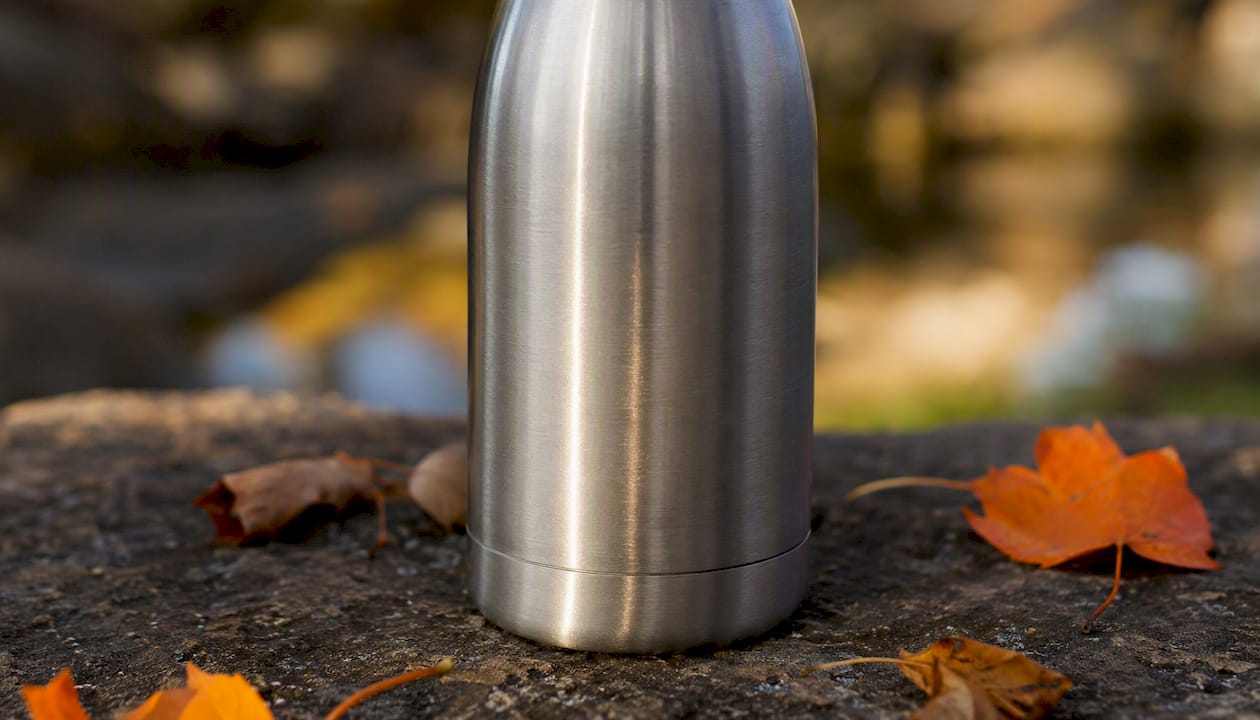
Reflective coatings. Polished stainless already reflects infrared reasonably well. Higher-end bottles add a copper or silver coating to the inner wall surface to further reduce radiative transfer. This is where vacuum quality and reflective finish work together: good vacuum alone isn’t enough if the inner surface absorbs radiation freely.
Structural bridges. The inner and outer walls must connect at the neck and base to hold the bottle’s shape. These connection points conduct heat directly, bypassing the vacuum gap. Quality manufacturers minimize bridge cross-section and use low-conductivity materials at these joints. Narrow-neck designs reduce the bridge area at the top, which is one reason narrow-mouth bottles often outperform wide-mouth versions for hot retention.
Lid and gasket construction. Silicone gaskets seal the lid against the bottle rim. Gasket degradation from dishwasher heat or UV exposure is a common cause of lid-related heat loss. Screw-top lids generally seal better than push-button or flip-top designs, though the latter are more convenient. Per ASTM-linked industry testing conventions, manufacturers should be consulted for product-specific thermal data since values vary with design and test method.
How to choose, test, and care for an insulated bottle
Decision checklist:
- Decide your required hold time. Under 4 hours: air-gap double-wall is adequate. Over 6 hours: vacuum insulation is the right choice.
- Check capacity vs weight. A 32 oz vacuum bottle weighs noticeably more than a 12 oz tumbler; match size to actual use.
- Evaluate lid type. Screw-top for maximum seal; push-button or flip-top for convenience with some thermal trade-off.
- Confirm “vacuum insulated” appears in the specs, not just “double-wall” or “stainless steel.”
- Check warranty terms. Lifetime or multi-year warranties signal manufacturer confidence in seal longevity.
Home tests to validate vacuum integrity:
- Fill the bottle with boiling water, seal it, and wait 2 minutes. Touch the outer wall. A good vacuum bottle stays cool or barely warm. A warm outer wall suggests compromised vacuum or an air-gap design.
- Fill with ice water in a humid room. No condensation on the outer surface after 10 minutes confirms an intact vacuum.
- For a timed retention check: fill with water at 200°F (just below boiling), seal, and measure temperature after 6 hours with a kitchen thermometer. A quality vacuum bottle should still read above 140°F.
Care checklist:
- Hand-wash the lid and gasket; dishwasher heat degrades silicone gaskets and can warp plastic lid components.
- Avoid dropping the bottle. Even a single hard impact can dent the outer wall and create a thermal bridge that bypasses the vacuum gap.
- Do not boil or pressure-wash the bottle; extreme heat at the seam can weaken the hermetic seal.
- If the outer wall starts feeling warm during hot-hold use or shows condensation during cold-hold use, the vacuum is likely compromised. Vacuum cannot be restored in consumer bottles, so replacement is the practical fix.
Is vacuum always the best option?
Vacuum insulation delivers the best thermal barrier per unit of wall thickness available in consumer drinkware. That said, “best” depends entirely on what you need.
For a 20-minute commute, an air-gap double-wall tumbler keeps coffee hot and costs less. For a full-day hike or a family picnic where you won’t have access to a cooler, vacuum insulation is the clear choice. The performance gap between vacuum and air-gap widens with time: at 2 hours the difference is noticeable; at 8 hours it’s dramatic.
Common misconceptions to clear up:
“Double-wall” does not mean vacuum. Packaging that says “double-wall stainless” may describe an air-gap design with no evacuated gap at all. Always look for “vacuum insulated” explicitly in the product description. Not all stainless steel bottles are vacuum-insulated; packaging that only says “double-wall” or “stainless steel” may be an air-gap design.
“Thermos” is not a generic product category. Thermos is a brand name, historically tied to vacuum flasks, but the term is used generically in everyday speech. A vacuum flask is the correct generic term for any insulating vessel that uses an evacuated gap to slow temperature change.
Sustainability note. Vacuum-insulated stainless bottles require more energy and materials to manufacture than single-wall or foam alternatives. The trade-off is longevity: a well-made vacuum bottle can last a decade or more, displacing hundreds of single-use cups. Stainless steel is also fully recyclable at end of life, which improves the lifecycle footprint compared to foam or plastic alternatives. There is no single superior insulator in all contexts; performance depends on use case, and the right choice balances hold time, weight, cost, and product lifespan.
How BANZ products apply these principles for families
BANZ designs its picnic drinkware around the practical trade-offs that matter most to parents: no condensation to protect bag contents, easy-clean lids for kids’ use, and durable materials that survive family outings.

BANZ Picnic Wine Insulated Stainless Tumbler (12 oz). The 12 oz insulated tumbler uses vacuum-insulated stainless steel walls, which means no sweating on the outer surface and no wet bag lining. At 12 oz, it’s a practical size for adults at a picnic without the weight penalty of a larger bottle. The lid design is a key spec to check: a tight-fitting lid on a small-capacity tumbler is critical because the opening-to-volume ratio is higher than on a large bottle, making lid quality proportionally more important.
BANZ Picnic Insulated Cooler Bag. The insulated cooler bag uses foam insulation in a soft-sided format, which suits family outings where packability and flexibility matter more than 24-hour cold retention. For picnic use (typically 4–6 hours), foam insulation is adequate and the soft construction is safer around children than rigid coolers.
Buying checklist for parents:
- Confirm “vacuum insulated” in specs for any bottle or tumbler intended for hot drinks or all-day cold retention.
- Check lid mechanism: push-button lids are convenient but require regular gasket inspection; screw-tops seal more reliably.
- Prioritize no-condensation exteriors to keep insulated bags dry and protect other bag contents.
- Choose stainless steel over plastic inner walls for durability and easy cleaning.
- For kids’ bottles specifically, lighter 12–18 oz sizes reduce the weight penalty of stainless vacuum construction.
The BANZ 32 oz stainless water bottle and the 18 oz travel cup with lid extend the range for families who need larger capacity or spill-proof functionality on the go.
A practical perspective on choosing drinkware for families
Most buying guides focus on hold-time numbers, but the real differentiator in family drinkware is the lid. A vacuum wall that performs beautifully in a lab test can be undone by a lid gasket that a child has chewed, a push-button mechanism that doesn’t fully seal, or a wide-mouth opening that exchanges air with every sip. The physics are settled: vacuum outperforms air-gap, and air-gap outperforms single-wall. What varies in real use is everything around the wall.
Parents choosing between a vacuum-insulated tumbler and a foam cooler bag aren’t making the same decision. The tumbler is for a single drink over hours; the bag is for a spread of food and drinks over an afternoon. Both are right for their job. The mistake is applying vacuum-bottle expectations to a foam bag, or assuming a foam bag can substitute for a vacuum bottle when you need an all-day hot drink.
BANZ products are selected with that distinction in mind: vacuum-insulated stainless for drinkware where hold time and condensation-free exteriors matter, and foam-insulated soft construction for the cooler bag where packability and flexibility are the priority.
BANZ family drinkware for your next outing
BANZ picnic drinkware gives families a no-guesswork path to the right insulation for each job. The vacuum-insulated stainless tumbler keeps drinks at temperature without sweating onto bag liners or picnic blankets, and the insulated cooler bag handles food and drinks for a full afternoon out. Both are built for the practical realities of family use: easy-clean lids, durable materials, and sizes that work for adults and older kids alike.
Check the full range of BANZ family-friendly drinkware and outdoor accessories at usa.banzworld.com. Not sure which option fits your outing? Visit the Ask an Expert page for direct guidance on BANZ products.
Sources
The following sources informed the science, performance data, and consumer guidance in this article. When reading manufacturer marketing claims, compare stated test conditions (starting temperature, ambient temperature, lid sealed or open) against these reference standards before accepting hold-time figures at face value.
