

TL;DR:
- A wide-brim hat can significantly reduce children’s facial UV exposure but is not a complete shield. Combining it with sunscreen, sunglasses, and shade ensures more effective sun protection, especially during high UV index conditions.
A properly designed wide-brim hat meaningfully reduces your child’s facial UV exposure, but it is not a complete shield. MD Anderson recommends treating a sun hat as a critical foundation, always paired with sunscreen, sunglasses, and shade. The role of wide brim hats in face protection is real and well-documented, but every parent should know the limits before heading outdoors.
- What a wide brim covers: direct UV reaching the face, ears, and neck
- What it doesn’t fully cover: reflected UV from water, sand, or pavement; the chin; diffuse sky radiation
- Single most important next step: pair the hat with broad-spectrum SPF 30+ sunscreen and UV-blocking sunglasses every outing
Table of Contents
- How do wide-brim hats actually reduce facial UV exposure?
- When is a hat enough, and when do you need to add sunscreen or shade?
- How to choose a wide-brim hat for your child
- Building a daily sun-safety routine around the hat
- Common myths about sun hats parents should stop believing
- How BANZ® products meet the criteria in this guide
- Key Takeaways
- The habit that matters more than the hat you buy
- BANZ® makes the checklist easy to act on
- Useful sources
How do wide-brim hats actually reduce facial UV exposure?
A wide brim works by creating a physical shade zone over the face. The wider the brim, the larger and deeper that zone, which cuts the direct UV beam reaching your child’s skin. A peer-reviewed modeling study found that during a cloudless summer day, a wide-brim hat reduced the mean facial UV dose to 1.7 SED (standard erythema dose), compared to 3.3 SED at midday without a hat. No hat tested reached 100% protection at any facial zone, with a maximum predictive protection factor (PPF) of 76%.
UPF rating and brim width accomplish different things. A UPF 50+ fabric blocks UV transmission through the hat material itself. Brim width creates shade geometry. You need both: a hat with a wide brim but loosely woven fabric still lets UV pass through the crown, while a tightly woven hat with a narrow brim leaves the face largely exposed.
| Brim Width | Typical Use Case | Relative Face Protection |
|---|---|---|
| Under 3 inches (baseball cap) | Casual/everyday | Low — ears and neck exposed |
| 3 inches | Everyday outdoor play | Moderate — face and ears shaded |
| 4 inches (~10 cm) | Beach, water, sand | Good — face, ears, neck shaded |
| A large wide brim | Maximum coverage | Best available, PPF up to 76% |
Statistic: A wide-brim hat reduced mean facial UV dose to 1.7 SED on a cloudless summer day, cutting exposure roughly in half compared to midday without a hat (3.3 SED) — yet the maximum protection at any single facial zone reached only 76%.
The sun’s angle matters too. Around midday, when the sun is nearly overhead, even a wide brim offers less shade because the UV beam comes from almost directly above. Larger brims still outperform smaller ones in most conditions, but no brim fully compensates for the sun’s high position.
When is a hat enough, and when do you need to add sunscreen or shade?
The hat-alone question has a clear answer: ARPANSA and Sunsmart guidance states that hats rarely suffice as standalone protection when the UV index reaches 3 or higher. In the United States, a UV index of 3 or above is common from late morning through mid-afternoon on most spring and summer days.
Situational guidance for parents:
- UV index below 3, early morning or late afternoon: a wide-brim hat plus a shaded area may be sufficient for brief outings
- UV index 3 or higher, midday (10 AM–4 PM): hat plus SPF 30+ sunscreen on all exposed skin, plus sunglasses
- Beach, pool, or boat: reflected UV from water accounts for roughly 25% of exposure, and sand reflects around 15% — the hat’s brim cannot block rays bouncing up from below, so sunscreen on the chin and neck is non-negotiable
- Snow or light-colored pavement: similar reflected UV risk; treat like beach conditions
- Playground or sports: movement shifts the hat’s angle constantly, creating gaps; sunscreen fills those gaps
Pro Tip: Make hat-wearing automatic by keeping it next to shoes. Kids who put on shoes before going outside will put on a hat the same way if it lives in the same spot. A comfortable, reversible hat with a fun pattern on one side is far more likely to stay on a toddler’s head than a plain one.
How to choose a wide-brim hat for your child
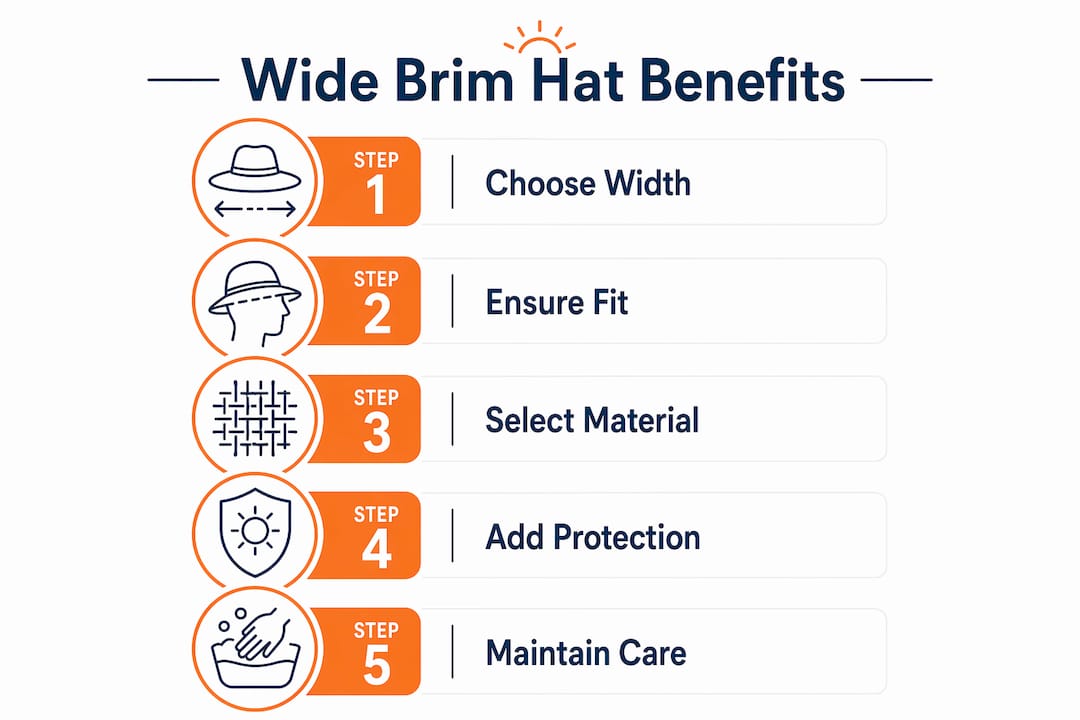
The single most important factor is brim width. Brim width guidance recommends at least 3 inches all around for everyday use and 4 inches or more for water and sand environments. UPF 30 is the minimum acceptable rating; UPF 50+ is preferred and is now widely available in children’s styles.

Fit and sizing
A hat that sits too high on the forehead leaves the face exposed. The brim should shade the ears and the back of the neck without the hat rocking forward or backward. Check fit by having your child look down: the hat should not fall off. Size by head circumference, not age, since children’s heads vary significantly. An adjustable toggle or drawstring inside the crown solves most sizing issues.
Chin straps keep hats on active kids, but the hardware matters. For infants and toddlers, use only breakaway or soft toggle chin straps. Avoid hard plastic clips or fixed ties that cannot release under pressure.
Material and color
Weave tightness determines fabric UPF more than color does. A tightly woven light-colored polyester or nylon hat often outperforms a loosely woven dark straw hat for UV blocking. Hold the fabric up to a light source: if you can see light through it clearly, UV passes through too. Canvas and tightly woven polyester are reliable choices. Loosely woven straw or open-weave styles are not.
Color affects heat comfort more than UV protection. Lighter colors reflect more heat, which matters for children in warm climates during prolonged wear.
Quick buying checklist
- Brim width: 3 inches minimum, 4 inches for beach or water
- UPF tag: UPF 30 minimum, UPF 50+ preferred
- Fabric check: hold to light; no visible gaps in weave
- Adjustable sizing: toggle or drawstring inside crown
- Chin strap: breakaway or soft toggle only for young children
- Packable and machine-washable for real-world use
Building a daily sun-safety routine around the hat
The routine is short: hat on, SPF 30+ applied to exposed skin, sunglasses on, seek shade when available. Repeat every outing. Sunsmart’s five-step checklist covers the same ground: slip on clothing, slap on sunscreen, slap on a broad-brimmed hat, seek shade, slide on sunglasses.
- Check fit before leaving the house: hat should sit low on the forehead and shade ears
- Apply SPF 30+ sunscreen to ears, neck, chin, and any exposed skin at least 20 minutes before going outside
- Put on hat and sunglasses together as one step
- Reapply sunscreen every two hours outdoors, or immediately after swimming or heavy sweating
- Store the hat properly after each use: open-brim up on a hook or shelf, never crushed in a bag
For washing, follow the label. Most UPF-rated polyester and nylon hats can be machine-washed on a gentle cycle and air-dried flat to preserve brim shape. Avoid high heat in the dryer, which can distort the brim and degrade the fabric’s UPF performance over time. If a hat gets wet outdoors, let it air-dry in its natural shape. Inspect chin straps and toggle hardware regularly for wear or loosening. Replace a hat when the weave looks stretched, holes appear, or the brim no longer holds its shape.
Common myths about sun hats parents should stop believing
No hat provides 100% protection. The peer-reviewed modeling study confirmed this directly: even the widest brim tested reached a maximum PPF of 76% at a single facial zone. Diffuse sky radiation and reflected UV reach the face regardless of brim size.
Myth vs. fact:
- Dark hats block more UV than light ones. Fact: weave tightness matters far more than color. A tightly woven light hat outperforms a loosely woven dark straw hat.
- A baseball cap protects the face. Fact: baseball caps leave ears, neck, and much of the face exposed. The CDC recommends a hat with a brim all the way around.
- The hat covers the chin. Fact: the chin is one of the most under-protected areas. Reflected UV from below and the hat’s geometry leave the chin exposed; sunscreen is required.
- A hat is enough at the beach. Fact: water reflects roughly 25% of UV, meaning rays hit the face from below the brim’s reach.
“For the most protection, wear a hat that has a brim all the way around that shades your face, your ears, and the back of your neck. A tightly woven fabric, such as canvas, works best to protect your skin from UV rays.” — CDC Sun Safety
Chin strap safety deserves a direct note. For infants and toddlers, breakaway chin straps are the only safe option. Hard toggles or fixed ties pose a strangulation risk. Check that any chin strap hardware releases easily under light pressure before putting the hat on a young child.
How BANZ® products meet the criteria in this guide
BANZ® designs children’s sun hats built around the checklist above: UPF 50+ rated fabric, child-focused fit, and practical features that increase the chance a child actually keeps the hat on. Wirecutter’s consumer testing perspective makes the point plainly: the most effective hat is the one a child will actually wear.
BANZ® hat features that match the buying checklist:
- UPF 50+ rated fabric, tested and certified
- Brim widths designed to shade face, ears, and neck
- Reversible styles with child-friendly patterns to encourage consistent wear
- Adjustable toggles for a secure, custom fit across head sizes
- Soft, breakaway-compatible chin strap design for infant and toddler safety
- Packable and machine-washable construction
The free BANZ Protect app adds a real-time UV monitoring layer. It tracks current UV index conditions so you know exactly when to add sunscreen, seek shade, or move indoors. Check the BANZ UV safety resources page for UV index guidance, and visit the Ask an Expert page for additional product and safety support. For age-specific fit guidance, the toddler sun hat fit guide covers sizing in detail.
BANZ® was founded in Australia by a family who couldn’t find adequate sun and noise protection for their own children. Their products now reach over 2 million families across six continents.
Key Takeaways
A wide-brim hat with UPF 50+ fabric significantly reduces facial UV exposure in children, but consistent use alongside sunscreen and sunglasses is what delivers reliable protection.
| Point | Details |
|---|---|
| Brim width is the primary factor | Use at least 3 inches for everyday play; 4 inches or more near water or sand. |
| No hat reaches 100% protection | The maximum PPF in peer-reviewed modeling was 76%; sunscreen covers the gaps. |
| Layer hat with sunscreen and sunglasses | Apply SPF 30+ to ears, chin, and neck 20 minutes before going outside. |
| Weave beats color for UV blocking | Tightly woven fabric outperforms loosely woven dark straw for UV protection. |
| BANZ® hats meet the full checklist | UPF 50+ rated, reversible, adjustable fit, and paired with the free BANZ Protect app. |
The habit that matters more than the hat you buy
Parents spend a lot of time comparing brim widths and UPF ratings, which is worth doing. But the research is clear on one thing: a technically perfect hat sitting in the car gives zero protection. Wirecutter’s guidance cuts through the noise here. Wearability is the real variable.
The practical fix is routine, not perfection. A reversible hat with a character your child picks out themselves, stored next to shoes, worn as a non-negotiable step before outdoor play, beats a high-spec hat that gets left behind. Keeping a spare in the diaper bag or car means you are never caught without one. Pair that habit with the BANZ Protect app’s real-time UV readings, and you have a system that works on busy mornings without requiring you to check the weather forecast separately.
The sun protection conversation with kids also starts earlier than most parents expect. Toddlers who wear hats consistently from infancy treat them as normal, not optional. That habit, built young, is worth more than any single product spec.
BANZ® makes the checklist easy to act on
BANZ® children’s sun hats deliver UPF 50+ protection with the fit, safety features, and kid-friendly designs that make consistent wear realistic. For parents who just worked through this guide, BANZ® is the direct path from “I know what to look for” to “I have it in the cart.”
Key features at a glance: UPF 50+ certified fabric, wide brims for full face and neck coverage, reversible styles, adjustable fit, breakaway-safe chin strap design, and machine-washable construction. The free BANZ Protect app monitors real-time UV conditions so you know when your child needs extra protection, not just when the clock says so.
For UV eye protection resources and the full range of children’s sun hats, visit BANZ® at usa.banzworld.com. Check the reversible UPF 50+ hat collection to find the right fit for your child today.
This article provides general sun safety information and is not a substitute for professional medical advice. Check current UV index conditions and consult a dermatologist for guidance specific to your child’s skin type and needs.
Useful sources
- CDC Sun Safety Facts — U.S. public health guidance on hat styles and fabric recommendations
- Vernez et al., Facial Exposure to Ultraviolet Radiation (DOI: 10.1111/phpp.12388) — peer-reviewed modeling study on hat protection effectiveness by style and brim width
- MD Anderson Cancer Center: What to Look for in a Sun Hat — dermatology expert guidance on layering sun protection
- ARPANSA: Sun Protection Using Hats — Australian public health authority guidance on hat styles and UV index thresholds
- Sunsmart Sun Protective Hats Info Sheet — Cancer Council five-step sun protection routine
- Wirecutter: Get More Sun Protection from Hats — consumer testing perspective on wearability and hat selection
- MsPineappleCrafts: Sun Protection Hat Guide — practical brim width, UPF, and weave guidance for consumers