

The best immediate move is a UPF 50+ breathable stroller shade paired with a UPF sun hat, timed around peak sun hours between 10 a.m. and 4 p.m. Skip the blanket over the handlebar. Check ventilation every few minutes, and never leave your baby unattended in the stroller, even for a quick errand. BANZ builds UPF 50+ kids’ sun gear designed around exactly this balance of coverage and airflow.
TL;DR:
- A UPF 50+ breathable stroller shade is essential for peak sun hours, but it must be properly fitted, ventilated, and used in combination with hats and clothing.
- Mesh covers are ideal for toddlers who want visibility and airflow, while blackout shades suit naps but limit sight and ventilation.
- Never leave a baby unattended in a stroller under protection, and avoid covering with blankets that trap heat and reduce airflow, increasing overheating risks.
- Reapply sunscreen every two hours during longer outings, and regularly adjust shade positioning to block shifting UV exposure as the sun moves.
- Choosing the right sun protection depends on the situation, stroller compatibility, and how often the gear will be used, favoring durable, well-rated UPF fabrics.
Table of Contents
- Stroller Sun Protection Methods: What Actually Works
- How Do You Choose the Right Stroller Sun Shade?
- Safety Rules Every Caregiver Should Know
- Setting Up and Maintaining Your Stroller Shade
- Why BANZ Recommends UPF 50+ With Breathable Design
- How Long Does Sun Protection Actually Last on a Long Outing?
- Comparing Materials for Durability and UV Blocking
- Layering Hats and UV Clothing With Stroller Shades
- Adjusting for Cloudy Days and Reflective Surfaces
- Does Stroller Color Really Affect Heat and Sun Exposure?
- A Caregiver’s Take on Naps, Curiosity, and Real Walks
- Shop BANZ UPF 50+ Sun Hats for Your Stroller Routine
- Sources
Stroller Sun Protection Methods: What Actually Works
Every parent eventually asks the same question at the park: shade or breeze? You rarely get both in equal measure, so the smartest approach is matching the method to the moment, not buying one shade and hoping it covers every situation.
Blackout-style nap shades create a dark, enclosed pocket over the seat. They’re built for babies who sleep best without visual stimulation, and the better ones use mesh panels rather than solid fabric to avoid trapping heat. SnoozeShade’s stroller cover is a commonly cited example, with claims of blocking nearly all UV rays while still allowing airflow through its mesh construction. The tradeoff is visibility: you lose the ability to glance at your baby without lifting fabric, and some babies resist the enclosed feel at first.
Ventilated mesh covers trade some of that blackout darkness for constant airflow and a clearer view of your child. These work well for toddlers who are awake, curious, and want to see the world roll by. They block meaningfully less ambient light than blackout designs, so they’re a weaker choice for a baby who naps hard in bright conditions.
Clip-on parasols attach to the stroller frame and swivel to follow the sun. Universal models, like the Maxi-Cosi parasol, claim compatibility with a wide range of stroller frames and typically include UPF 50+ protection. Parasols shine on walks where the sun angle keeps shifting, since you can reposition them without stopping. They’re less useful for straight overhead sun, where a small disc simply can’t cover enough ground.
Canopy extenders clip onto your stroller’s existing hood to stretch the shadow further down toward your baby’s legs and feet. They’re a low-cost fix if your stroller’s factory canopy leaves a sunny gap, but they add bulk and can catch wind on breezy days.
Mosquito nets with UPF backing solve two problems in one layer, useful for evening walks or trips where bugs are as much a concern as sun. Standard bug netting offers little UV protection on its own, so check that a net is specifically UPF-rated before counting on it for sun.
Hats and UPF clothing round out the system rather than replacing it. A stroller shade blocks the sun coming through the canopy gap, but a wide-brim hat protects the face and neck even when your baby sits up or leans forward.
Here’s how the trade-offs break down by situation:
- Naptime on a bright day: blackout shade with mesh ventilation panels
- Awake toddler who wants to watch the world: ventilated mesh cover or parasol
- Shifting sun angle during a walk: clip-on parasol you can swivel
- Gap between canopy and baby’s legs: canopy extender
- Evening walks near water or grass: UPF-rated mosquito net
- Every scenario, as a baseline layer: UPF 50+ hat and light clothing
Windy days complicate all of these. A blackout shade can act like a small sail, and a parasol arm can bend or snap in a strong gust. On those days, a snug-fitting UPF hat and clothing often outperform any add-on accessory, simply because nothing is flapping or pulling at the frame.
How Do You Choose the Right Stroller Sun Shade?
Shopping for stroller sun protection gets easier once you stop asking “which one is best” and start asking “best for what.” A shade that’s perfect for a napping newborn can be the wrong pick for a toddler who wants to people-watch.
Run every product you’re considering through the same six dimensions:
- Best for nap or visibility? Decide this before anything else. A nap-focused caregiver wants darkness; a visibility-focused caregiver wants mesh and a clear sightline. BabyCanTravel’s shade comparison frames this as the single biggest factor separating blackout covers from parasols and ventilated designs.
- What’s the actual UPF rating and coverage area? UPF 50+ blocks the vast majority of UV radiation, but the rating only matters if the fabric covers the areas that need it, including the sides where low-angle sun sneaks in.
- How breathable is the fabric? Look for mesh panels or a fabric description that mentions air permeability, not just “lightweight.”
- Does it actually fit your stroller? Universal clips and elastic loops don’t guarantee a snug fit on every frame. Check the product listing against your stroller’s brand and model before buying.
- How easy is it to attach, remove, and adjust one-handed? You will be doing this while holding a squirming toddler, so test it in-store if you can.
- What’s the price relative to how often you’ll use it? A $15 clip-on parasol for occasional walks is a different calculation than a $40 shade for daily nap-time strolls.
Pro Tip: Bring your stroller’s model number (or a photo of the frame) when shopping in person. Sales staff can check compatibility on the spot, which saves you a return trip if a “universal” shade turns out not to be.
Think of the decision as a simple flow. Naps first, then everything else follows. If naps are your priority, start with blackout or heavy-mesh shades and confirm they have ventilation panels before buying. If visibility and airflow matter more, go straight to ventilated mesh or a parasol. If bugs are a factor on top of sun, look specifically for a UPF-rated net rather than assuming any mesh product doubles as sun protection.
One more filter worth applying: how many times will you actually use this item per week? A shade you’ll use daily justifies spending more on breathable, well-tested fabric. An occasional-use item doesn’t need to be your top-of-the-line pick.
Safety Rules Every Caregiver Should Know
Sun protection gear only works if you use it correctly, and the most common mistakes aren’t about picking the wrong product. They’re about how that product gets used once it’s on the stroller.
The single biggest rule: never leave your infant unattended in the stroller, covered or not. A shade is not a babysitter, and covering the stroller can make it harder to notice if your child is in distress. Caregivers should also avoid direct sun exposure whenever it’s practical, according to safety guidance on stroller covers, which specifically warns against draping regular blankets over a stroller.
That last point deserves emphasis. A blanket thrown over the handlebar to block sun traps heat with almost no airflow, and it blocks your view of your baby entirely. It’s one of the most common and most dangerous habits parents fall into, usually out of convenience rather than carelessness.
Draping a blanket over a stroller can trap heat inside the enclosed space, raising the risk of overheating even on a mild day.
Watch for these overheating signs during any outing longer than 20 or 30 minutes:
- Flushed or unusually red cheeks
- Damp hair or sweat at the neck and hairline
- Rapid breathing or unusual fussiness
- Skin that feels hot to the touch, particularly on the chest or back
Air-permeable mesh matters here more than most parents realize. A stroller’s interior can function like a small greenhouse. Reporting on common stroller mistakes points out that shade design should manage this micro-environment, blocking UV rays while still letting warm air escape rather than sealing it in.
Sunscreen adds a layer of complexity for the youngest babies. The FDA generally advises against using sunscreen on infants under six months, recommending shade and protective clothing as the primary defense instead. For babies older than six months, a broad-spectrum sunscreen becomes a reasonable addition to shade and clothing, not a replacement for either. Reapply every two hours during a long outing, and immediately after any contact with water, since sweat and splashing both reduce how long sunscreen stays effective.
Setting Up and Maintaining Your Stroller Shade
A shade that’s attached wrong can be worse than no shade at all, since a loose clip or a flapping panel becomes its own distraction. A few minutes of setup upfront saves you from readjusting every ten minutes on your walk.
- Check the fit before you leave the house. Clip or strap the shade onto your stroller frame and give it a firm tug from a few angles. It shouldn’t shift or sag under light pressure.
- Test the brakes and straps. Make sure the shade’s attachment points don’t interfere with the brake lever or block access to the harness buckle. You need both fully functional in an instant.
- Reposition as the sun moves. A parasol needs periodic adjustment through the day; a fixed shade may need to be angled or extended as the sun drops lower in the afternoon.
- Do a five-minute test walk. Push the stroller around the block once before a longer outing to confirm nothing rattles loose.
- Clean according to the fabric label. Most UPF fabrics tolerate a gentle hand wash with mild soap; harsh detergents and high heat in a dryer can degrade the UV-blocking treatment over time.
- Store it dry and out of direct sun. UV-blocking fabrics slowly lose effectiveness with prolonged sun exposure even in storage, so a drawer or bag beats leaving it clipped to the stroller in the garage all winter.
Why BANZ Recommends UPF 50+ With Breathable Design
One brand began when a family created sun and hearing protection gear for their kids, shaping a product line of UPF 50+ sun protection paired with breathable construction. They also offer a free app that provides real-time UV and noise monitoring to caregivers.
Every criterion covered in this guide, UPF rating, fabric breathability, ease of fit, maps directly onto how some sun protection gear is designed. That’s not a coincidence; it’s the same logic that shapes such products. For a deeper walk-through of UPF 50+ fabric and what the rating actually means for your child’s skin, BANZ’s guide on UPF protection breaks it down further, and the brand’s toddler outdoor shade collection is worth a look if you’re assembling a full outdoor kit rather than buying one item at a time.
How Long Does Sun Protection Actually Last on a Long Outing?
A UPF 50+ fabric doesn’t wear off over the course of an afternoon the way sunscreen does. The weave itself blocks UV, so a shade or hat that rated UPF 50+ this morning still rates UPF 50+ at sunset, provided the fabric isn’t stretched, torn, or soaked through in a way that changes its density.
Sunscreen is the piece that needs active management on a long outing. Reapply every two hours as a baseline, and immediately after swimming, heavy sweating, or wiping your baby’s face with a damp cloth. A morning application does not carry you through an all-day outing, no matter how high the SPF number on the bottle.
Shade positioning needs its own kind of maintenance. As the sun moves across the sky, a shade or parasol angled correctly at 10 a.m. may leave a gap by 1 p.m. Get in the habit of glancing at your baby’s exposed skin, hands, feet, and face, every 20 to 30 minutes and nudging the shade or parasol to close any new gap.
For outings longer than two hours, treat the whole system as something to actively manage rather than set and forget. Check the shade angle, check for overheating signs, and check whether it’s time for another sunscreen application if your baby is old enough for it. That rhythm matters more than any single product’s rating.
Comparing Materials for Durability and UV Blocking
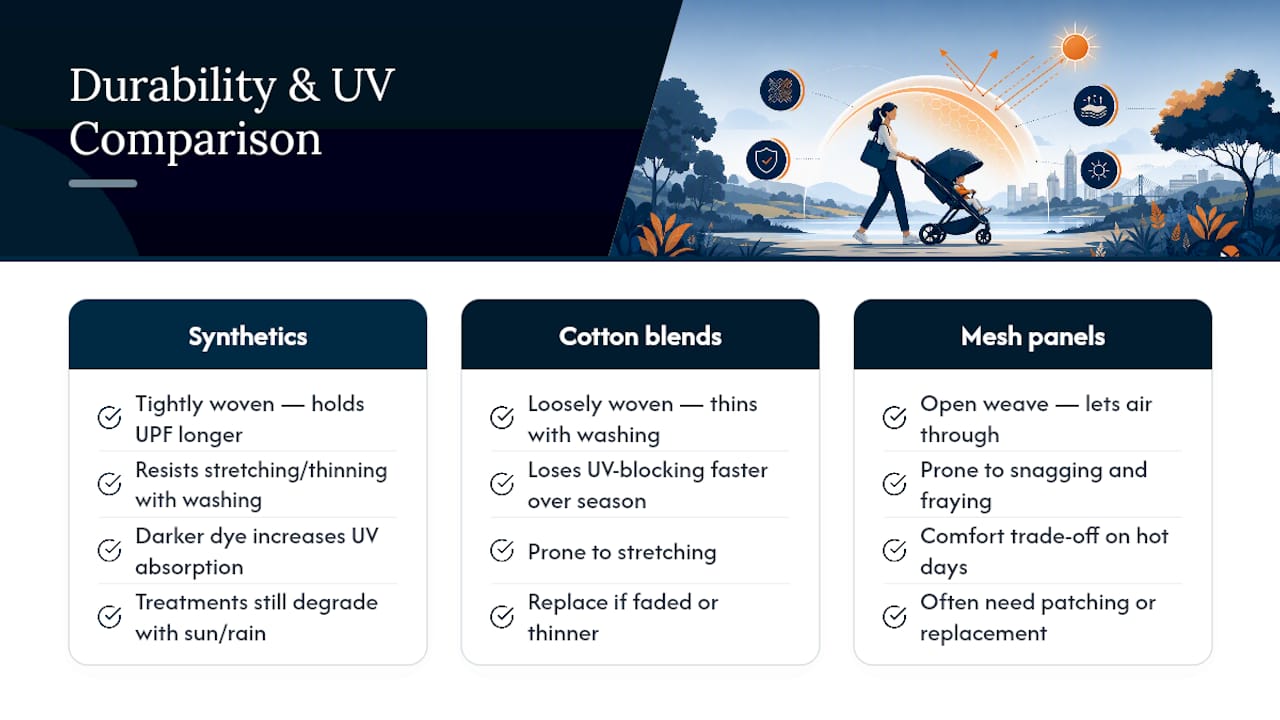
Not every fabric marketed as “sun protective” holds up the same way over a season of regular use. Tightly woven synthetic fabrics, common in dedicated UPF products, tend to hold their UV-blocking rating longer than loosely woven cotton blends, which can stretch or thin with repeated washing.
Mesh panels used in ventilated covers introduce a durability trade-off of their own. The open weave that lets air through also makes the fabric more prone to snagging or fraying at the edges compared to a solid blackout panel. That’s a reasonable trade for comfort on hot days, but it means mesh sections often need replacing or patching before a solid-panel shade does.
Color and dye quality affect UV blocking more than most parents expect. Darker, more saturated colors generally absorb more UV before it reaches the skin underneath, while pale or bleached fabric lets more radiation pass through, even at the same thread count. This is separate from the UPF rating itself, which measures the finished product, but it explains why two shades with similar fabric weights can perform differently in bright conditions.
Rain and repeated sun exposure both degrade UV-blocking treatments over time. A shade left clipped to an outdoor stroller storage spot year round will likely lose effectiveness faster than one stored indoors between uses. If a shade or hat starts looking faded or the fabric feels thinner than when you bought it, that’s a reasonable cue to replace it rather than assume the original rating still holds.
Layering Hats and UV Clothing With Stroller Shades
A stroller shade covers the space above and around your baby, but it rarely seals every gap, especially once a baby sits up, reaches forward, or kicks a leg out from under the canopy. That’s where hats and UV-protective clothing close the loop.
A wide-brim or bucket-style UPF hat protects the face, ears, and neck, areas a stroller canopy often misses when the sun sits at a low angle in the morning or evening. Look for a chin strap or elastic band; a hat that blows off within the first block of your walk isn’t protecting anyone.
Long-sleeve UPF shirts and pants matter most for babies and toddlers who tend to push a blanket or cover aside, which is common once a child is mobile enough to grab at fabric. Clothing stays on the body itself, so it doesn’t depend on the stroller cover staying perfectly positioned.
Layer these together rather than picking one: shade for the stroller’s interior, hat for the face and neck, UPF clothing for arms and legs. That layered approach also gives you flexibility. If your toddler pulls off a hat mid-walk, the shade and clothing are still doing their job.
Adjusting for Cloudy Days and Reflective Surfaces
Clouds feel like they should mean a break from sun protection, but UV rays pass through cloud cover more than most parents expect, and a bright overcast day can deliver a meaningful dose of UV even without direct sunlight. Keep the shade and hat routine consistent regardless of visible sun.
Reflective surfaces add another layer worth planning around. Sand, water, concrete, and light-colored pavement all bounce UV back upward, which means a baby facing a beach or a bright sidewalk gets hit from below in addition to overhead exposure. A stroller shade blocks the top and sides well, but reflected light sneaking in from underneath is harder to catch, so a hat with side coverage and UPF clothing on the legs matter more in these settings.
Windy days, discussed earlier for their effect on parasols and blackout covers, also tend to come with cooler air that can trick caregivers into skipping sun protection altogether. Wind doesn’t reduce UV exposure, and a breezy day at the coast often has some of the highest reflective UV of any outing. Treat wind as a comfort factor, not a sun-safety one.
Does Stroller Color Really Affect Heat and Sun Exposure?
Dark stroller frames and canopies absorb more heat from direct sunlight than light-colored ones, which means a black stroller left parked in full sun can get noticeably hotter to the touch than a gray or tan model in the same spot. That heat radiates into the seating area, adding to whatever warmth builds up from reduced airflow under a cover.
This matters most at the touchpoints your baby actually contacts: the seat fabric, the harness buckle, and any metal frame parts near the legs. A quick touch test before placing your baby in the seat is a simple habit, especially after the stroller has sat parked in direct sun for more than a few minutes.
Canopy color plays a role too, separate from the shade or cover you add on top. A lighter canopy reflects more sunlight, while a darker one can intensify the shaded pocket’s temperature even while blocking light effectively. If you’re choosing between stroller models and sun exposure is a real concern in your climate, a lighter-colored frame and canopy is a reasonable tiebreaker, though it’s a secondary factor compared to a good UPF shade and consistent ventilation checks.
A Caregiver’s Take on Naps, Curiosity, and Real Walks
Balancing a baby’s need for shade against a toddler’s need to see the world isn’t a product problem so much as a stage-of-life problem. For a nap-dependent infant, a snug blackout cover with mesh panels solves both light and warmth in one move. For a curious toddler craning to see every dog and delivery truck, that same blackout cover becomes a fight you’ll lose daily. Ventilated mesh or a parasol respects what that child actually needs.
Before any walk, run a quick check: hat on, shade or parasol positioned, quick touch test on the seat, and sunscreen if your baby is old enough for it. That thirty-second habit matters more than any single product you buy.
— Shari M. Murphy
Shop BANZ UPF 50+ Sun Hats for Your Stroller Routine
BANZ is the alternative to guessing whether a hat actually blocks UV. Every style carries a UPF 50+ rating built into the fabric itself, so you’re not relying on a loose bandana or a hat that looks protective but isn’t rated at all.
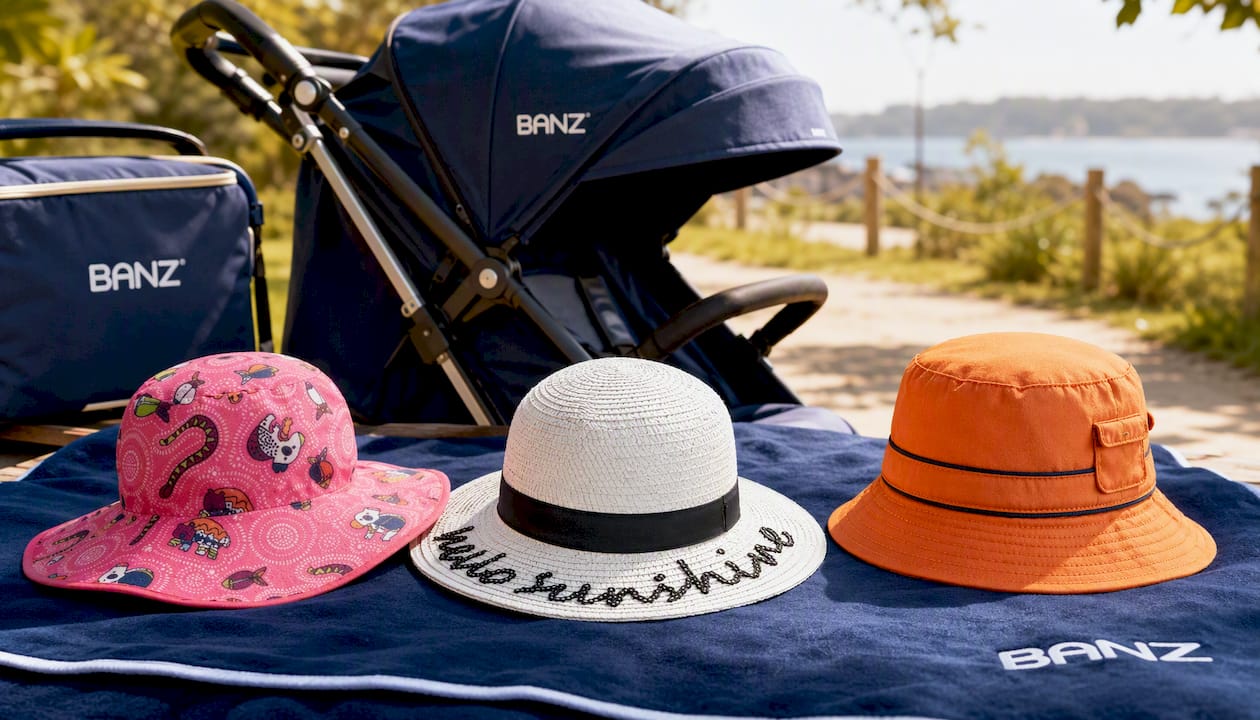
The Toddler Reversible Sun Hats with UPF 50+ Protection give you two color options in one hat, useful for matching outfits or just getting more wear out of a single purchase before your toddler outgrows it. If your child wants something with a little more personality, the Hello Sunshine Sunhat with Sequins delivers the same UPF 50+ coverage with a design kids are more likely to actually keep on their heads. For caregivers packing light, the Children’s Sun Hats with UPF 50+ Protection with Pocket include a built-in pocket for a folded snack or a small toy, one less thing to carry separately in the diaper bag.
Check current stock before you order, since specific colorways sell out first during summer months. Browse the full toddler sun hat collection and get your child’s UPF 50+ gear sorted before your next walk.
Sources
For deeper reading on the claims in this guide: the FDA’s guidance on infant sunscreen, a safety warning on covering strollers with blankets, and BabyCanTravel’s comparison of stroller sun shades. For packing and product guidance, BANZ’s own diaper bag sun essentials checklist rounds out what to carry on your next outing.
- Why covering your stroller with a blanket is dangerous
- Should you put sunscreen on infants? — FDA
- 10 Best Stroller Sun Shades For Travel (And Better Baby Naps) — BabyCanTravel