

The main tumbler lid types are screw/thread, slide, flip, straw, chug/spout, and 360/hybrid. Only screw/thread lids with a compressed gasket are reliably leakproof. Pick screw or latched flip lids for anything that rides in a diaper bag or backpack. Save slide, straw, or chug lids for desk sipping, workouts, or supervised snack time at the table.
TL;DR:
- Screw or latched flip lids with a properly seated gasket offer the most reliable leakproof seal, especially for travel and bag carry.
- Slide, straw, and chug/spout lids are better suited for desk sipping, active use, or supervised snack time, but are less leakproof.
- When selecting a lid, measure your tumbler’s rim diameter and check if it is screw-thread or press-fit to ensure proper fit.
- Regularly inspect and replace gaskets to maintain seal integrity and prevent leaks over time.
- For caregivers, screw or flip lids are safest in crowded or jostling environments, while straw and slide lids excel at specific routines like desk or supervised use.
Table of Contents
- What Are the Different Tumbler Lid Types?
- Which Tumbler Lid Type Fits Your Routine?
- How Do I Check Tumbler Lid Fit Before Buying?
- What Materials Keep a Tumbler Lid Working Longer?
- A Caregiver’s Take on Choosing the Right Lid
- BANZ Tumblers Built Around These Exact Lid Choices
- FAQ
What Are the Different Tumbler Lid Types?
Every tumbler lid solves the same problem, keeping liquid in, but each one trades leakproofing for convenience differently. Knowing how each seal actually works tells you more than any marketing copy on a box.
Screw/thread lids twist onto matching threads on the tumbler body, compressing a silicone gasket between the lid and rim. That compression is what makes the seal reliable even sideways in a bag, but you need two hands (or a steady grip) to open and close it, which slows you down at a stoplight.
Slide lids use a small plastic tab that slides over a drinking port. They’re fast for one-handed desk sipping, but the open port means any tip or jostle sends liquid out. Not bag-safe, full stop.
Flip-top lids pop open with a thumb press. Basic flip tops seal loosely around a spout; latched flip tops add a locking clasp that presses the spout shut, closing the gap between “convenient” and “trustworthy.” The latch is also the part most likely to wear out or snap over time.
Straw lids route liquid through an internal tube instead of an open spout. They’re the go-to for kids and for workouts because sipping requires almost no tilt, but that tube is a magnet for mold and buildup if you can’t pull it apart to scrub.
Chug/spout and 360-degree lids are built for active use, hiking, running, the car cup holder, not for a bag. Chug lids open into a wide spout for fast drinking; 360 lids let you sip from any point around the rim, which is handy in a moving vehicle but offers no leak protection when the tumbler tips over.
Hybrid lids, a screw-on threaded base paired with a secondary flip or slider opening, are increasingly common because they let you keep the leakproof base seal while still sipping without unscrewing the whole lid. Many caregivers find these the best middle ground for a routine that mixes commuting and desk time.
Which Tumbler Lid Type Fits Your Routine?
Choosing the right lid style comes down to five practical questions: does it leak in a bag, can you open it one-handed, is it easy to clean, does it take a straw, and what’s it actually built for.
- Bag-safe/leakproof: screw/thread wins outright; hybrid lids come close if the base is threaded.
- One-handed convenience: flip and slide lids are fastest; screw lids are slowest.
- Cleanability: simple flip and screw lids with removable gaskets are easiest; straw lids need the most attention.
- Straw compatibility: straw lids and some hybrids only; chug and 360 lids don’t support one.
- Best use case: screw for travel, slide or flip for the desk, straw for kids and workouts, chug/360 for the car.
Only screw-on lids with a properly seated gasket should be called reliably leakproof; slide and flip designs are better described as spill-resistant, meaning they handle a bump on the counter but not a sideways tumble in a diaper bag. That distinction shows up constantly in product reviews where a “leakproof” claim turns out to mean “fine if it stays upright.”
A few quick scenarios make the choice concrete. Commuting with a bag: screw or hybrid, no exceptions. Sitting at a desk all day: slide or basic flip, since you’re not moving it much. Gym bag or stroller cup holder: straw lid, easy sipping without tilting. Kids’ snack table at home: straw or slide, supervised, so leak risk barely matters. Car rides with toddlers: 360 or chug lid in the cup holder, never loose in a bag. Comparisons of lid categories consistently place slider and straw lids at the top for desk and active hydration, while screw-on stays the pick for travel.
How Do I Check Tumbler Lid Fit Before Buying?
A lid that looks right in a photo can still be the wrong size for your tumbler. Measure before you order, especially for replacement lids.
- Measure the tumbler’s inner rim diameter where the lid seats, and the outer diameter if the lid wraps around the rim instead of dropping inside it.
- Check whether the opening is threaded (screw-fit) or smooth (press-fit); the two are not interchangeable even if the size matches.
- Compare your measurement against the manufacturer’s listed spec rather than eyeballing it against a lid you already own.
- Watch for handled mugs and tapered rims, two common gotchas that make a “standard” lid sit crooked or refuse to seal.
- Inspect the gasket for flattening, cracks, or a gummy texture; a lid can be the correct size and still leak if the gasket is worn.
Lids attach two ways, press-fit or screw-thread, and mixing them up is the single most common replacement-lid mistake. If you’re buying for a group or picking a gift, a screw or latched flip lid on a body with a base under roughly 70 millimeters tends to fit the widest range of cup holders and bags without complaints.
Pro Tip: If a screw lid feels gritty or won’t seat flush no matter how many turns, don’t force it. Pull the gasket out, rinse the groove it sits in, and reseat it before assuming the lid itself is defective.
What Materials Keep a Tumbler Lid Working Longer?
Lid material affects both how long it lasts and how safe it is to run through repeated wash cycles. Tritan plastic resists clouding and cracking better than cheaper polypropylene, which is why it shows up on higher-end lids, while polypropylene is lighter and cheaper but scratches and stains faster over time. Silicone gaskets are the actual seal, and they wear out well before the rigid plastic around them does.
- Hand-wash slider tracks and hinge points; dishwasher heat can warp small moving parts faster than the plastic body.
- Pull straws out for cleaning whenever the lid allows it; a straw that can’t be disassembled for hand-washing is a recurring hygiene complaint for a reason.
- Check gaskets monthly for tackiness or flattening, and replace one as soon as you notice a seal isn’t holding, since most leaks trace back to the gasket, not the lid shape itself.
A Caregiver’s Take on Choosing the Right Lid
If you’re juggling a diaper bag, a stroller, and a toddler who grabs at everything, the screw or latched flip lid is the one that lets you stop worrying about what’s happening inside the bag. Save slide and straw lids for moments you can actually watch the cup, snack time, the car seat tray, the desk. A typical morning routine might use a screw-top travel cup for the commute and a straw cup in the car for the ride home. For more on matching lid style to your day, our guide on choosing a tumbler versus a water bottle breaks it down further.
— Shari M. Murphy
BANZ Tumblers Built Around These Exact Lid Choices
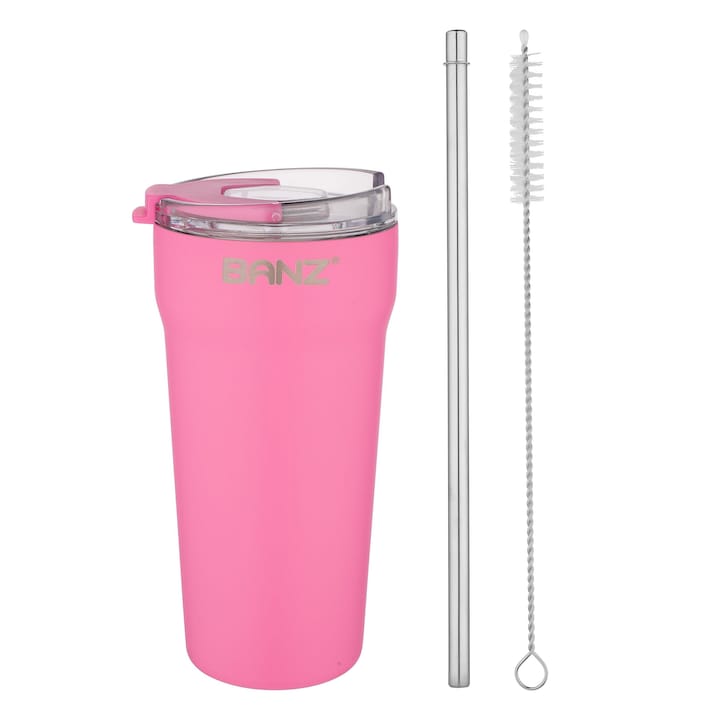
BANZ builds its travel drinkware around the same rule this article just laid out: bag-carry gets a leakproof seal, and everything else gets convenience. The Travel Spill-Proof Travel Cup with Lid 18oz uses a screw/latched flip seal designed for exactly the bag-safe scenario described above, commutes, diaper bags, stroller pockets, anywhere the cup gets jostled sideways.
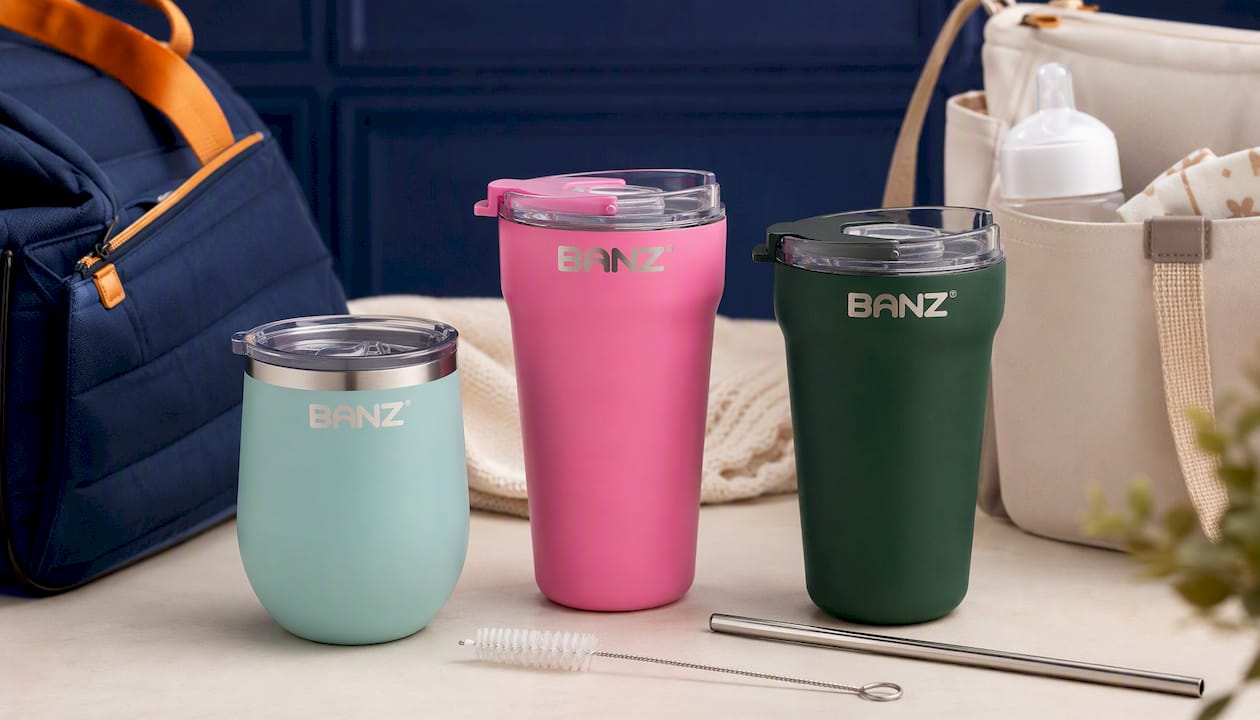
If you need a smaller size for a cup holder or a child’s grip, the Travel Spill-Proof Travel Cup with Lid 14oz carries the same bag-safe seal in a more compact build. For picnics, patios, or a sip you actually want to enjoy slowly, the Picnic Wine Insulated Stainless Tumbler 12oz pairs insulation with a lid built for that upright, seated-outdoors routine rather than a bag toss. Browse the full lineup on BANZ’s shop and pick the size that matches how you actually move through your day.
FAQ
What Are the Main Types of Tumbler Lids?
The main types are screw/thread, slide, flip, straw, chug/spout, and 360/hybrid. Each seals differently, and only screw/thread designs with a compressed gasket are considered reliably leakproof.
What Are the Different Types of Bottle Lids?
Bottle lids largely mirror tumbler lids: screw caps, flip spouts, straw caps, and push/pull chug spouts. The screw cap remains the standard for bottles meant to travel in a bag since it’s the only style that seals fully under pressure and movement.
What’s the Difference Between Leakproof and Spill-Resistant Lids?
Leakproof means the lid holds liquid in even when the tumbler is tipped, dropped, or shaken, which is true of properly gasketed screw lids. Spill-resistant means it handles a light bump upright but can still leak if it’s laid on its side, which describes most slide and flip lids.
How Do I Know if a Replacement Lid Will Fit My Tumbler?
Measure your tumbler’s inner and outer rim diameter, then confirm whether the original lid is press-fit or screw-thread before ordering. Manufacturer specs matter more than eyeballing a lid that looks similar, since even small diameter differences prevent a proper seal.
What’s the Best Lid for Kids’ Tumblers?
Straw lids work best for supervised sipping since they need almost no tilt to drink, and slide lids are fine at a snack table you’re watching. For anything going into a bag or stroller pocket, a screw or latched flip lid, like the one on BANZ’s 18oz travel cup, keeps things dry between stops.