

TL;DR:
- Sound pressure level measures how loud a sound is in decibels and poses risks to children’s hearing at high levels.
- Parents should monitor noise using dBA-weighted measurements and limit exposure time to protect kids’ ears.
Sound pressure level (SPL) is the measure of how strong a sound is, expressed in decibels (dB), and even small increases carry significantly higher risk to a child’s ears. The single most useful number to know: a baseline safe exposure limit commonly used by health agencies is the baseline safe exposure limit. That window shrinks fast as noise climbs. At higher sound levels, the safe exposure time for a child decreases sharply.
Three trusted sources shape the guidance in this article:
- NIDCD (National Institute on Deafness and Other Communication Disorders) explains the logarithmic decibel scale and cumulative hearing damage.
- NIOSH (National Institute for Occupational Safety and Health) sets the exposure limits that form the basis of child hearing safety recommendations.
- BANZ® and the free BANZ Protect app give parents practical tools to monitor noise and protect kids at outdoor events.
Table of Contents
- What does sound pressure level actually mean?
- Why dBA matters more than raw dB for child safety
- How loud is too loud? Common sounds and safe exposure times
- How to measure noise levels as a parent
- How hearing protection works: NRR explained
- Practical steps to protect your child’s hearing outdoors
- Signs your child may have hearing damage
- Key Takeaways
- Why children’s hearing safety deserves more attention than it gets
- BANZ hearing protection: sized for kids, rated for real events
- Useful sources
What does sound pressure level actually mean?
Sound pressure is the tiny fluctuation in air pressure a sound wave creates as it travels. When a speaker cone or a jet engine pushes air molecules together and apart, those pressure changes reach your child’s eardrum. SPL measures how large those fluctuations are, compared to the quietest sound a healthy human ear can detect: a reference pressure of 20 µPa (micropascals).
The formula is straightforward: SPL = 20 × log₁₀(p / p₀) dB, where p is the measured pressure and p₀ is that 20 µPa reference. Because it uses a logarithm, the dB scale compresses an enormous range of pressures into numbers parents can actually use.
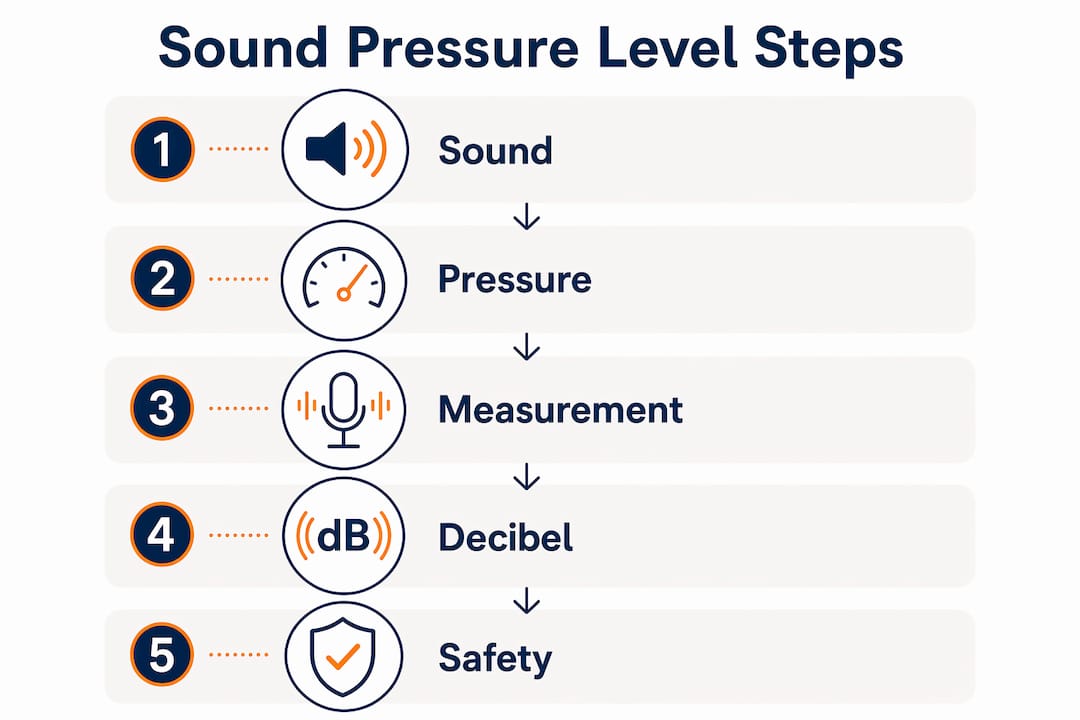
Here is why the logarithm matters. A 10 dB increase means ten times more intensity, and sounds roughly twice as loud to the human ear. A 3 dB increase doubles the physical intensity of the sound. So moving from 85 dB to 95 dB is not a 12% jump — it is ten times the energy hitting your child’s ears. Parents consistently underestimate how fast the risk rises.
Why dBA matters more than raw dB for child safety
Not all frequencies damage hearing equally. Human ears are most sensitive to sounds in the 1,000–4,000 Hz range and less responsive to very low or very high frequencies. A raw SPL reading treats all frequencies the same, which can make a sound seem safer than it is.
A-weighted decibels (dBA) apply a filter that mirrors how the ear actually responds across the frequency spectrum. That is why every major health agency, including NIOSH and the CDC, uses dBA for hearing-safety guidelines. When you check a noise-monitoring app or read a product spec, dBA is the number that tells you whether your child’s ears are at risk.
Different weighting suffixes you may see:
- dBA — A-weighted; standard for hearing safety and everyday monitoring
- dBC — C-weighted; used for low-frequency and peak measurements
- dBZ — unweighted (flat); used in technical acoustics, not safety guidance
Pro Tip: When using a smartphone app or sound level meter outdoors, always select the dBA setting. A high-frequency noise source like a power tool or a stadium PA system can read lower on an unweighted scale yet still carry significant hearing risk at those frequencies.
How loud is too loud? Common sounds and safe exposure times
The article categorizes common sounds by typical dBA levels and indicates that as noise levels increase, the safe exposure time decreases accordingly.
Key figure: 85 dBA / 8 hours is the baseline threshold. Every 5 dB increase above that cuts the safe exposure time roughly in half.
Noise exposure is cumulative. A child who attends a 90-minute soccer game at 95 dBA and then rides home past a construction site has already stacked up significant exposure for the day. Both intensity and total duration count. Short bursts at high levels add up just as surely as a single long exposure.
How to measure noise levels as a parent
Smartphone apps vs. sound level meters
Smartphone apps are convenient and accurate enough for everyday decisions. Apps like NIOSH’s SLM app (iOS) use the phone’s built-in microphone and display dBA readings in real time. Dedicated sound level meters (SLMs) are more precise and better for sustained monitoring, but most parents do not need lab-grade accuracy to make a protective decision at a park or parade.
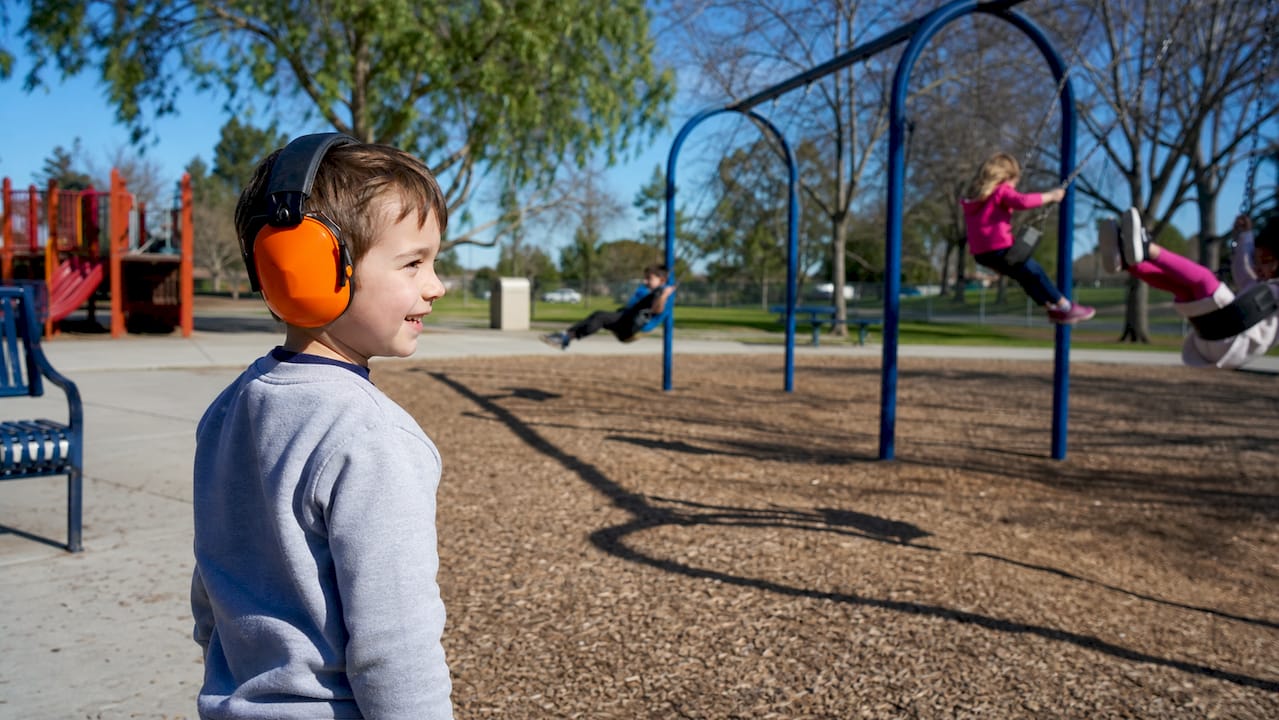
The free BANZ Protect app goes a step further: it monitors both UV and noise levels in real time, giving parents a single tool for outdoor safety checks.
Measurement checklist for outdoor use
- Open your app and confirm it is set to dBA (A-weighted).
- Hold the phone or meter at your child’s ear height, not yours.
- Point the microphone toward the noise source.
- Wait 15–30 seconds and note the average reading, not just the peak.
- Check the peak reading too — brief spikes above 100 dBA matter even if the average looks safe.
- If the average exceeds 85 dBA, put earmuffs on your child before continuing.
How hearing protection works: NRR explained
The Noise Reduction Rating (NRR) is the number printed on every pair of earmuffs sold in the United States. It represents the maximum attenuation measured in a controlled lab setting. BANZ® earmuffs carry an NRR of 26 dB, which is among the higher ratings available for children’s products.
Lab conditions are ideal. Real-world use is not. A child who moves, fidgets, or wears the earmuffs slightly off-center gets less attenuation than the label suggests. A conservative real-world estimate is to subtract 7 from the NRR and divide by 2. For BANZ earmuffs: (26 − 7) ÷ 2 = approximately 9.5 dB of reliable real-world reduction. That still brings a 100 dBA environment down to roughly 90 dBA — a meaningful difference in safe exposure time.
Key figure: A moderate real-world noise reduction on the order of several decibels can significantly increase safe exposure time.
When selecting child earmuffs, check for:
- Certified NRR rating printed on the packaging
- Child-specific sizing — adult earmuffs do not seal properly on small heads
- Adjustable headband for a snug, consistent fit
- Lightweight construction so kids will actually keep them on
Practical steps to protect your child’s hearing outdoors
Use this checklist at parks, sports events, parades, and any noisy outdoor activity.
- Check the noise level first. Open BANZ Protect or a dBA app before the event starts.
- Put earmuffs on before it gets loud, not after. Damage from a sudden spike happens fast.
- Choose your position. At a loud sporting event, move your child away from speakers and PA systems.
- Schedule quiet breaks. Step away from the noise source for 10–15 minutes every hour.
- Check the seal. Press the earmuff cups gently against your child’s head and confirm there is no gap. Hair, hat brims, and glasses frames all break the seal.
Pro Tip: Pairing earmuffs with behavior changes, like choosing a seat farther from the stage or leaving before the loudest finale, reduces cumulative exposure more than earmuffs alone. Protection and positioning work together.
Youth coaches and event organizers can also play a role. Resources on parent communication at youth events can help families coordinate protective measures before games get underway.
Signs your child may have hearing damage
Act quickly if you notice any of the following:
- Speech delays or unclear speech in a child who previously spoke well
- Not responding to soft sounds or their name at a normal volume
- Complaints of ringing, buzzing, or muffled sounds after a loud event
- Turning up the TV volume higher than usual
- Ear pain or a feeling of fullness after noise exposure
Next steps: Document the exposure (date, location, estimated dBA if available), then call your child’s pediatrician. Ask specifically for an audiology referral. Bring any monitoring readings from BANZ Protect or your app to the appointment.
Untreated noise-induced hearing loss in children can affect speech development, reading, and academic performance well into the school years.
Key Takeaways
Sound pressure level (SPL) measures noise intensity in decibels, and because the scale is logarithmic, even a 3 dB rise doubles the sound energy reaching your child’s ears.
| Point | Details |
|---|---|
| SPL and the dB scale | SPL measures sound strength relative to 20 µPa; a 10 dB increase means ten times more intensity. |
| Use dBA for safety | A-weighted dBA readings reflect how the human ear responds and are the standard for hearing-safety decisions. |
| 85 dBA / 8-hour rule | Exposure above 85 dBA for more than 8 hours risks hearing damage; at 100 dBA, safe exposure time drops to around 14 minutes. |
| Exposure is cumulative | Both intensity and total duration matter; short loud bursts across a day add up to real risk. |
| BANZ earmuffs and app | BANZ® earmuffs (NRR 26 dB) and the free BANZ Protect app give parents rated protection and real-time monitoring. |
Why children’s hearing safety deserves more attention than it gets
Most parents know to apply sunscreen before heading outside. Far fewer think to check the noise level before a parade or a youth sports game. The gap is understandable: hearing damage is invisible and painless in the moment. A sunburn shows up within hours; noise-induced hearing loss builds quietly over months and years.
What the research makes clear is that the dB scale’s logarithmic nature means parents are routinely surprised by how quickly risk accumulates. A soccer game at 100 dBA feels like a normal Saturday. But at that level, a child without protection reaches their safe daily exposure limit in about 14 minutes. That is not a fringe scenario; it is a typical weekend afternoon.
The practical tools exist: a free app, a well-fitted pair of earmuffs, and a basic understanding of dBA readings. The BANZ Kids Noise Safety Resource Library is a good starting point for parents who want to go deeper on any of these topics.
BANZ hearing protection: sized for kids, rated for real events
BANZ® earmuffs are built specifically for children’s head sizes, with an adjustable headband, a certified NRR 26 dB rating, and lightweight construction that kids will actually tolerate through a full game or show. That combination of proper fit and certified attenuation is what makes the difference between protection that works and earmuffs that get pulled off after five minutes.
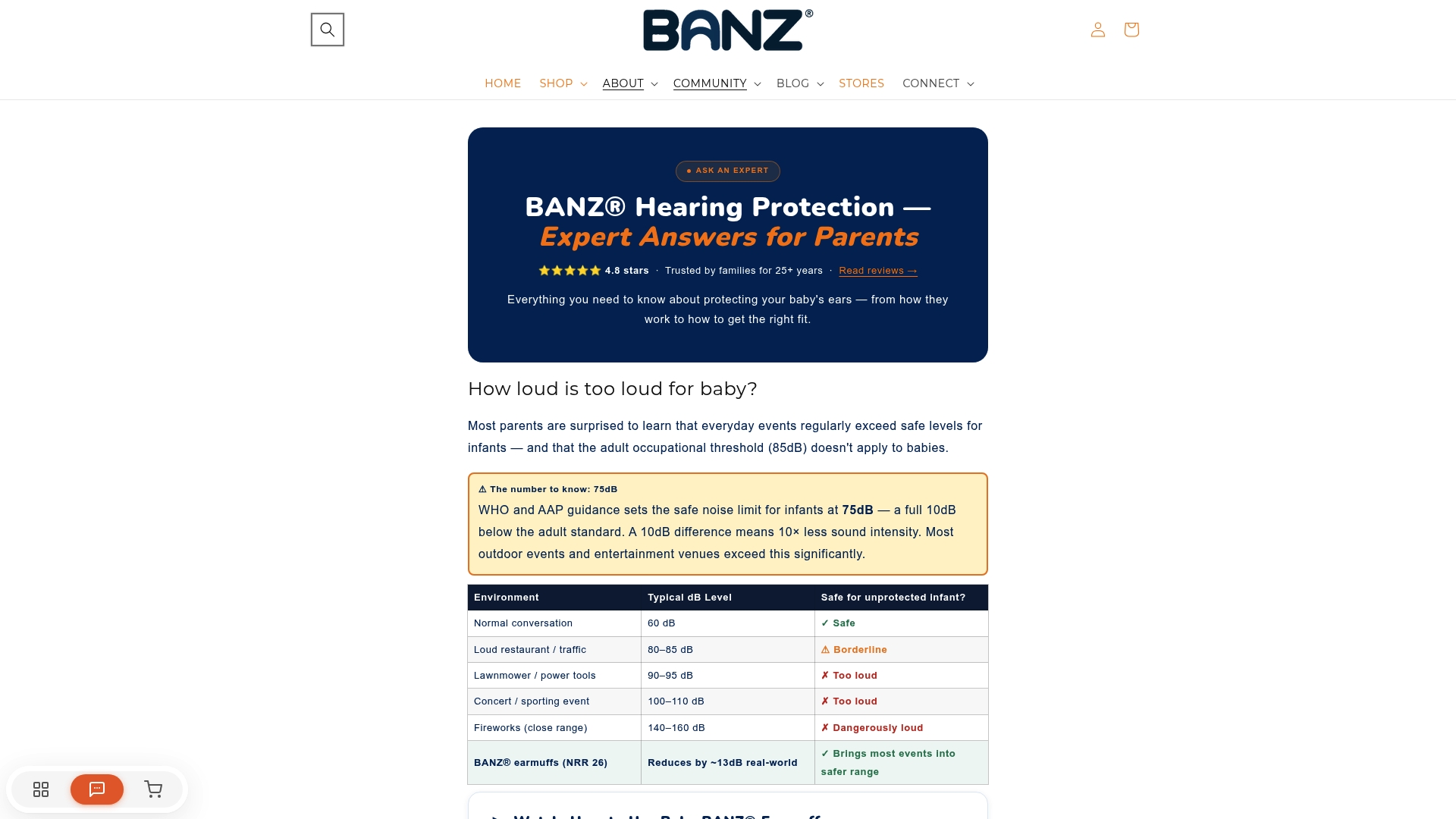
The free BANZ Protect app pairs with your outdoor routine to monitor noise and UV levels in real time. The Kids Noise Safety Resource Library gives you downloadable guides, exposure charts, and product guidance in one place. For a detailed breakdown of NRR ratings and how to choose the right protection for your child’s age and activity, visit the NRR vs. SNR parent guide and find the right fit today.
Useful sources
- How Is Sound Measured? | NIDCD — Explains the decibel scale, logarithmic intensity, and exposure-duration examples including the 85 dBA / 8-hour baseline.
- Sound Level Measurements | NTI-Audio — Defines SPL, the 20 µPa reference pressure, and practical measurement methods.
- Sound Pressure Level (SPL) | Svantek Academy — Covers A-weighting, frequency sensitivity, and why dBA is the standard for health monitoring.
- Sound Pressure | Wikipedia — Reference for weighting conventions (dBA, dBC, dBZ) and SPL definitions.
- Baby Earmuffs NRR vs SNR | BANZ® — Parent-focused guide to rating systems and real-world attenuation expectations.
- Kids Noise Safety Resource Library | BANZ® — Curated hub of noise safety guides, exposure charts, and product resources for families.
- Noise Safety for Children | BANZ® — Practical advice on everyday sound risks and protective steps for parents.
Recommended
- Noise Safety for Children: Everyday Sounds Parents Should Watch |BANZ® – BANZ® Carewear USA
- Kids Noise Safety Resource Library | Hearing Protection & Sensory Support | BANZ® – BANZ® Carewear USA
- Noise Sensitivity in Children: Parent Strategies & Hearing Protection | BANZ® – BANZ® Carewear USA
- How Earmuffs Reduce Sound Explained for Parents – BANZ® Carewear USA