

Use UV Index 3 as your practical threshold. At or above this level, the CDC recommends active sun protection for skin, and for babies that means shade and covering, not sunscreen alone. Infants under 6 months need shade and clothing first because FDA guidance advises checking with a doctor before applying sunscreen at that age. The checklist below breaks this down by index range so you can act fast, whether you’re packing the stroller or already at the park.
TL;DR:
- Babies under 6 months should be kept out of direct sun whenever the UV Index reaches 3 or higher, relying primarily on shade and protective clothing.
- A UV Index of 3 can cause unprotected infant skin to burn more quickly due to their thinner skin and less melanin production.
- Reflective surfaces like water and sand can intensify UV exposure, especially near water or beaches, raising the effective UV level.
- For babies 6 months and older, sunscreen with mineral filters is recommended as a supplement to clothing and shade, applied generously and re-applied every two hours.
- Rescheduling outdoor activities during UV Index 8 and above, or limiting time outside to deep shade, drastically reduces the risk of sunburn and overheating.
Table of Contents
- What does the UV Index actually measure?
- How do you protect infants under 6 months from the sun?
- When can babies start wearing sunscreen safely?
- Practical UV Index checklist for babies
- How do you spot sunburn or overheating in a baby?
- Should you put a baby in the sun for vitamin D?
- BANZ® in practice: gear that fits the shade-first approach
- A brief, practical reassurance to parents
- Find BANZ® baby sun gear and the free UV alert app
- Sources
- FAQ
What does the UV Index actually measure?
The UV Index runs from 0 to 11+, and it measures the strength of ultraviolet radiation reaching the ground at a given time and place. A reading of 2 or below poses low risk for most people. Once it climbs to 3 or higher, the CDC advises protecting your skin, and that guidance becomes stricter for babies, whose skin is thinner and produces less melanin than an adult’s.
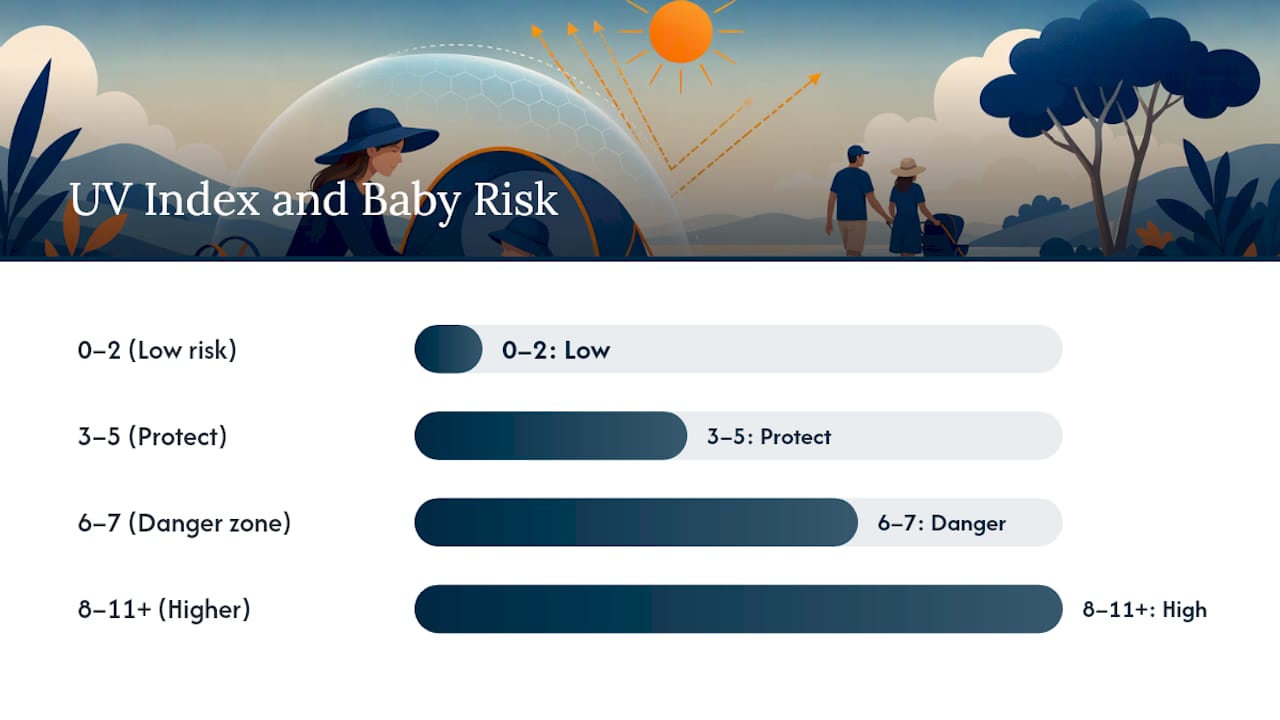
For a baby, “protect your skin” translates into something more concrete: get out of direct sun, cover exposed areas, and time outings around the forecast. The AAP frames this the same way, prioritizing shade and clothing over any sunscreen for infants over 6 months, and using sunscreen only as a backup layer.
A few details catch parents off guard:
- Cloud cover cuts UV exposure but does not eliminate it. A hazy, overcast day can still carry a UV Index of 4 or 5.
- Reflective surfaces intensify exposure even when the index reads moderate. Water, sand, snow, and concrete all bounce UV back onto skin that’s already facing the sun, according to the CDC Yellow Book.
- Peak hours run roughly from 10 a.m. to 4 p.m., when the sun sits highest and UV intensity peaks regardless of temperature.
That last point matters more than most parents expect. A cool, breezy 72 degree morning at the beach can still deliver a UV Index of 7 by late morning, well into the danger zone for a baby’s bare skin.
How do you protect infants under 6 months from the sun?
The plainest rule for this age group: keep infants out of direct sun whenever the UV Index hits 3 or higher, and skip the midday window altogether if you can help it. The AAP recommends shade and clothing as the primary defense at this stage, not sunscreen.
Here’s a practical sequence for planning any outing with a young infant:
- Check the forecasted UV Index before you leave. Most weather apps show it alongside temperature; treat 3 as your cutoff for planning outdoor time.
- Dress your baby in tightly woven, lightweight fabric. Long sleeves and pants block more UV than loose cotton, and a UPF-labeled hat with a brim wide enough to shade the neck and ears adds a second layer.
- Bring portable shade. A stroller canopy, clip-on umbrella, or pop-up shade tent creates a buffer, though shade alone still lets in reflected UV, so pair it with clothing rather than relying on it solo.
- Pack for the outing, not just the destination. A UPF hat, a lightweight cover layer, a stroller shade attachment, and water for hydration cover most scenarios.
- Try sunglasses if your baby tolerates them. Not every infant will keep them on, but wrap-around styles that block peripheral light help protect developing eyes during longer outings.
Pro Tip: Check the UV forecast the night before an outing, not the morning of. Planning your walk or park trip for before 10 a.m. or after 4 p.m. avoids the worst of the day’s exposure without changing your entire routine.
If you’re weighing sunscreen for a baby this young, the FDA advises asking your pediatrician first. Healthychildren adds that sunscreen on small exposed areas is only a fallback when shade and clothing genuinely aren’t available.
When can babies start wearing sunscreen safely?
Once your baby turns 6 months old, sunscreen becomes a legitimate part of the routine, but it’s still a supplement to shade and clothing, not a replacement for them. Both the AAP and HealthyChildren.org frame it this way: cover first, then apply sunscreen to whatever skin is still exposed.
Choose broad-spectrum sunscreen with an SPF in the range commonly recommended by pediatric authorities. Mineral filters like zinc oxide and titanium dioxide tend to be gentler on young, sensitive skin than chemical formulas, which makes them a common pediatric recommendation for this age group.
A few application details separate effective use from a false sense of security:
- Apply a generous layer 15 to 30 minutes before heading outdoors so it has time to bind to skin.
- Reapply every two hours, and immediately after swimming or towel-drying, regardless of what the water-resistance claim on the bottle says.
- Check ears, the back of the neck, the tops of feet, and the backs of hands. These are the spots parents miss most often, and they burn just as easily as the forehead or cheeks.
- Skip spray sunscreens for wiggly infants. Sprays are hard to apply evenly and easy to inhale by accident.
- Keep sunscreen away from eyes and mouth, and do a small patch test first if your baby has sensitive or eczema-prone skin.
Practical UV Index checklist for babies
Once you know the day’s UV Index, the decisions get simple. Here’s how to plan around each range:
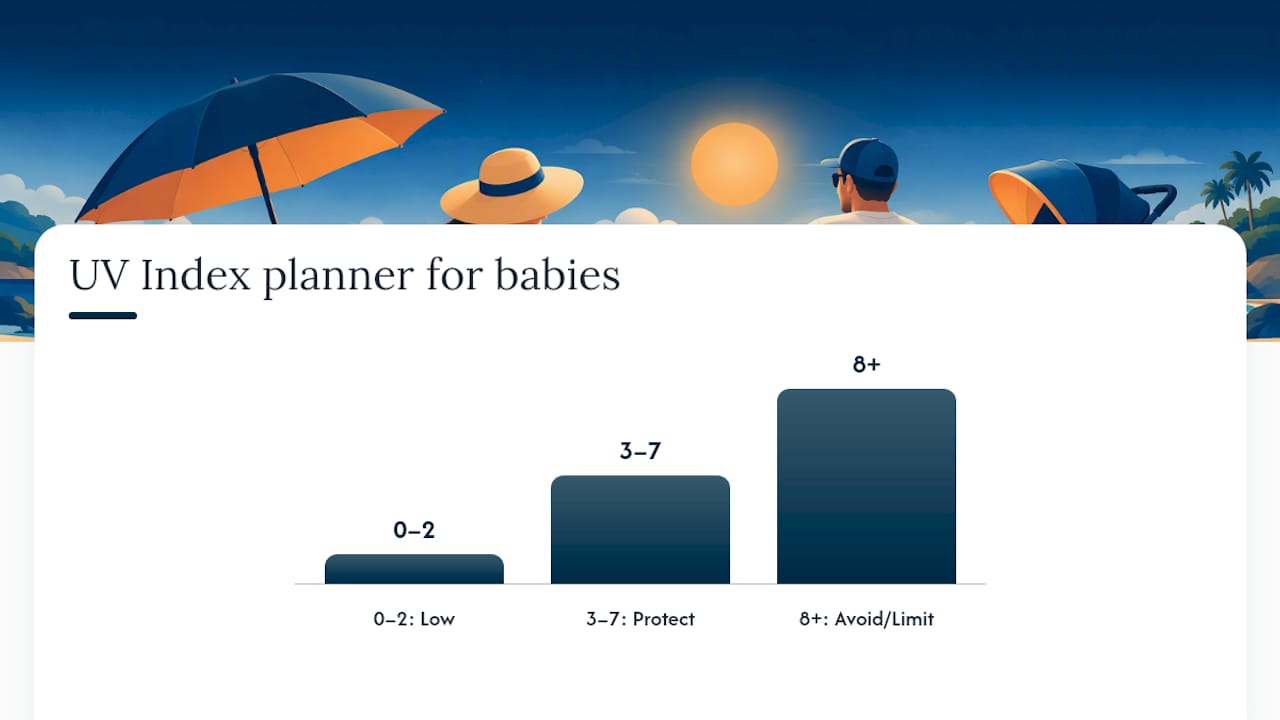
- UV Index 0 to 2 (low). Risk is minimal, but shade is still smart for extended outings, especially around midday. Keep an eye on the clock even on a “safe” day.
- UV Index 3 to 7 (moderate to high). This is the active protection zone. Cover up with UPF clothing, add a wide-brim hat, use sunglasses if your baby tolerates them, and apply sunscreen to exposed skin for babies 6 months and older.
- UV Index 8 and above (very high to extreme). Reschedule outdoor plans if you can, or limit time outside dramatically. If you must go out, stick to deep shade, full UPF coverage, and strong eye protection.
Reflective surfaces push these numbers higher than they look. A pool deck or sandy shoreline at UV Index 5 can behave more like a 7 once you factor in the bounce-back, so treat any outing near water, sand, or pavement with an extra layer of caution.
For a deeper breakdown of how the UV Index 3 cutoff plays out at the stroller, BANZ’s guide on packing a sun kit walks through the same threshold with specific gear recommendations.
How do you spot sunburn or overheating in a baby?
Babies can’t tell you when their skin is starting to burn or when they’re overheating, which is exactly why active monitoring matters more than waiting for obvious symptoms, according to the AAP.
Watch for these signs:
- Sunburn: redness, skin that’s warm or painful to the touch, blistering, or unusual fussiness that doesn’t settle with feeding or comfort.
- Overheating: lethargy, vomiting, fewer wet diapers than usual, or skin that feels hot without sweating.
If you spot either, move your baby into shade or indoors right away, cool the skin with damp cloths, remove excess layers, and offer fluids appropriate for their age. The CDC recommends contacting a healthcare professional promptly for these symptoms, and seeking emergency care for severe blistering, signs of dehydration, or any significant burn in a very young infant.
Should you put a baby in the sun for vitamin D?
No. Pediatric guidance is consistent on this point: vitamin D needs should come from diet or supplementation, not deliberate sun exposure. The skin damage risk to an infant far outweighs any theoretical benefit from sunlight, and there’s no safe “dose” of intentional UV exposure for a baby.
If you’re concerned your baby isn’t getting enough vitamin D, that’s a conversation for your pediatrician, not a reason to skip the shade.
BANZ® in practice: gear that fits the shade-first approach
Every rule above points to the same conclusion: cover first, add sunscreen later, and know your UV Index before you leave the house. That’s the thinking behind BANZ’s product lineup and the free BANZ Protect app, which sends real-time UV alerts so you know when a walk needs a hat and when it needs to wait.
- Baby Wrap Around Sunglasses, Bubzee Polarized Wrap Around for eye protection during longer outings.
- Baby Beachcomber Wrap Around Sunglasses as a snug-fit alternative for active babies.
- Baby Wrap Around Sunglasses, Bubzee Wrap Around for parents who want a simpler, no-frills style.
- BANZ Protect app for real-time UV and noise monitoring, free to download.
Pairing UPF hats with wrap-around sunglasses covers two of the biggest gaps parents miss: the eyes and the ears, both areas that burn easily and get overlooked mid-outing.
A brief, practical reassurance to parents
Sun safety for a baby doesn’t require perfection, just consistency: check the index, favor shade, cover up, and let an app do the watching when your hands are full.
— Shari M. Murphy
Find BANZ® baby sun gear and the free UV alert app
A shade-first approach can make sun safety easier to follow without turning every outing into a research project. Apps that provide real-time UV information help parents know when to use sunglasses, a hat, or extra shade before leaving the house.
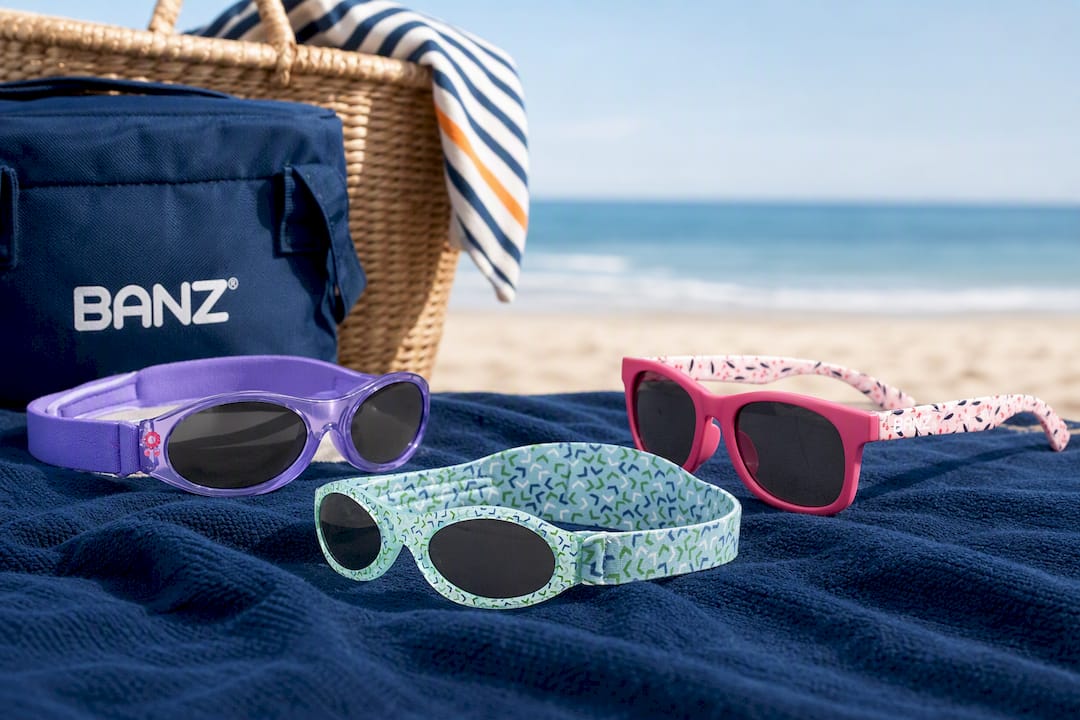
Three sunglasses options give you room to pick what actually stays on your baby’s face: the Bubzee Polarized Wrap Around for glare-heavy days at the beach or pool, the Beachcomber Wrap Around for a snugger everyday fit, and the Bubzee Wrap Around as a simpler alternative. Pair any of them with a UPF 50+ hat and you’ve covered the two spots parents forget most: eyes and ears. Browse the full lineup, including sun hats and swimwear, at BANZ’s shop and download the BANZ Protect app to start getting UV alerts before your next outing.
This article is general information, not a substitute for advice from a qualified doctor. Consult a qualified healthcare professional about your own circumstances before acting on anything here.
Sources
- Sun safety facts | Skin Cancer | CDC
- Sunscreen: How to help protect your skin from the sun | FDA
- Sun protection: What parents need to know | AAP Patient Education
- Healthychildren
FAQ
What Would a UV Index of 3 Do to a Baby’s Skin?
At UV Index 3, unprotected infant skin can start to burn faster than adult skin because it’s thinner and produces less natural pigment. That’s why the CDC treats 3 as the point to start active protection: shade, covering clothing, and limiting time outdoors.
My 4-Month-Old Got Sunburned. What Should I Do?
Move your baby out of the sun immediately and cool the skin with damp, cool cloths, not ice. Offer fluids appropriate for their age, and contact your pediatrician promptly, since infants under 6 months with any noticeable sunburn should be evaluated by a professional according to CDC guidance.
Can I Take My 3 Month Old Out in the Sun?
Yes, but plan around the UV Index and avoid direct sun when it reads 3 or higher. Use shade, a stroller canopy, and lightweight covering clothing rather than sunscreen, since the FDA advises checking with a doctor before applying sunscreen to infants under 6 months.
What Temperature Range Is Considered Safer for Sleep and SIDS Risk?
Pediatric guidance generally recommends keeping a baby’s sleep environment comfortably cool rather than warm, since overheating is a recognized risk factor. This is a separate concern from sun exposure, and questions about safe sleep temperature are best directed to your pediatrician for guidance specific to your baby.
Do I Need Sunscreen if My Baby Wears a UPF Hat?
Not always. If a UPF 50+ hat and clothing cover most of your baby’s skin, sunscreen becomes a backup for whatever’s left exposed, like the face or hands, for babies 6 months and older. For babies under 6 months, shade and clothing remain the primary defense, with sunscreen used only when covering isn’t possible.